


Arturia AudioFuse 16Rig

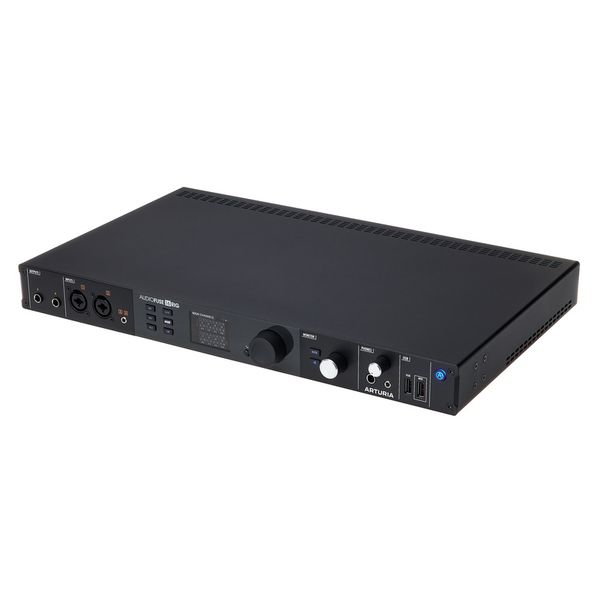
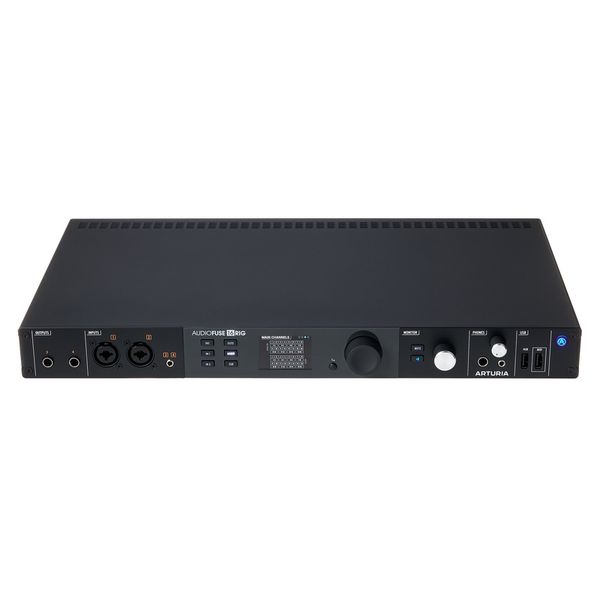
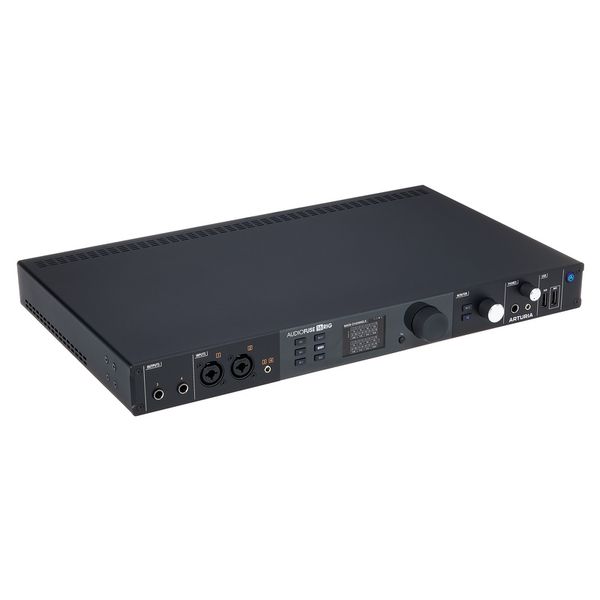
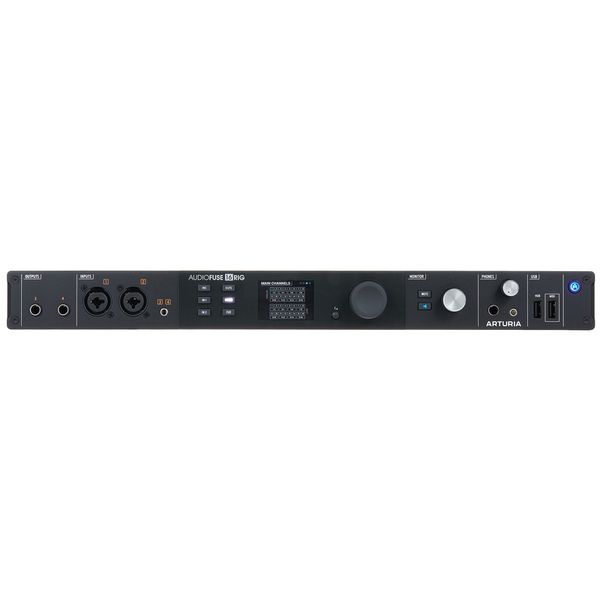
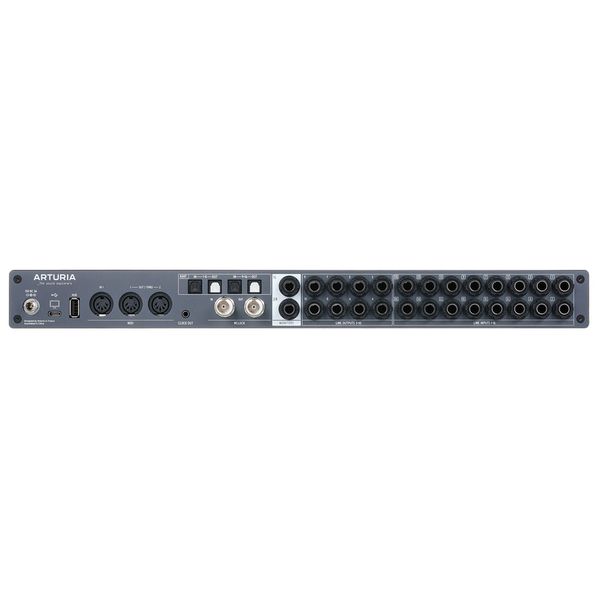
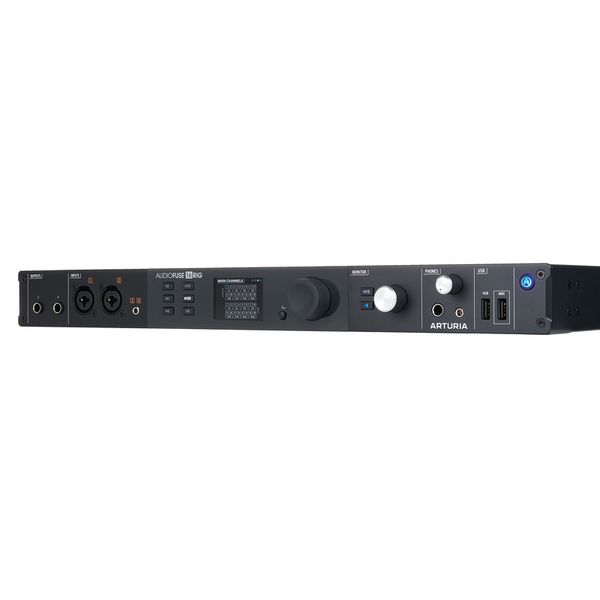
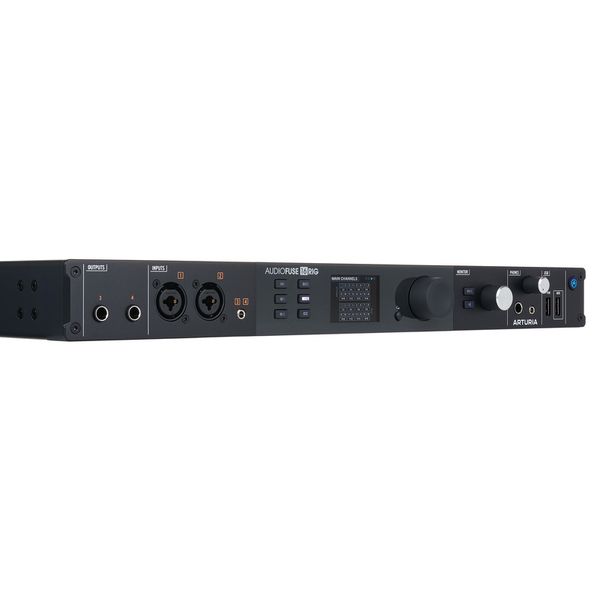


USB Audio Interface with USB-C Port
- Combines connectivity with flexible configuration options
- To connect a full synth studio, complex live audio routing, DAW recording and more
- 24-bit / 192kHz
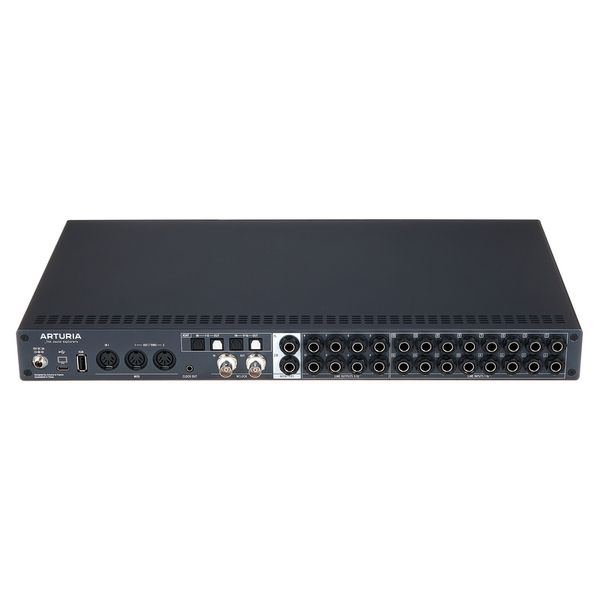
- 16 analogue input channels and 12 analogue output channels
- Up to 16 channels of immersive audio monitoring (via firmware update)
- Separate front stereo input (input 3/4) for connecting tablets, smartphones or synths
- Dual ADAT I/O ports with word clock synchronisation
- Low Latency DSP Mixer
- Standalone audio and MIDI functionality
- Dedicated monitor volume control with mute and custom buttons to control studio monitors
- Custom buttons configurable (mono, dim or alternate speaker)
- Headphone volume control
- Reamp function
- Pad switch for all line inputs
- Colour display with rotary and push encoders
- Six direct access buttons and Back/Home buttons for easy navigation
- USB hub functionality with front and rear USB ports for connecting peripherals
- Load and recall presets for quick setup (e.g. studio, live performance, streaming, etc.)
- Configurable for desktop or rackmount use
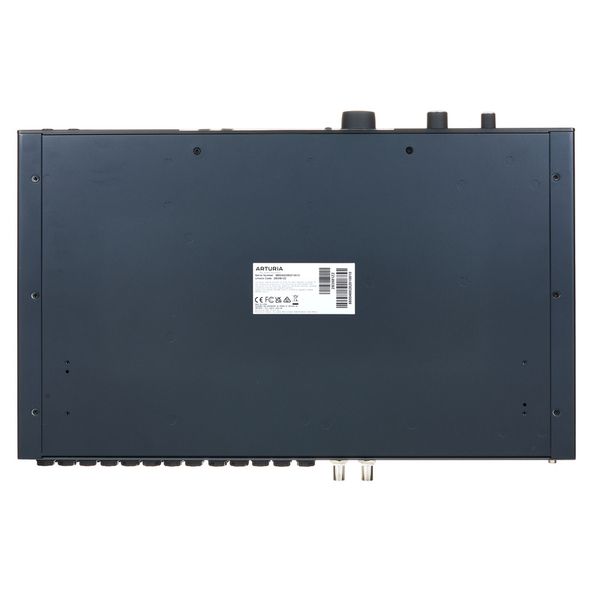
- Format: 19"/ 1U
- Dimensions (W x H x D): 440 x 45 x 260 mm
- Weight: Approx. 4.5 kg
- Includes AudioFuse Creative Suite
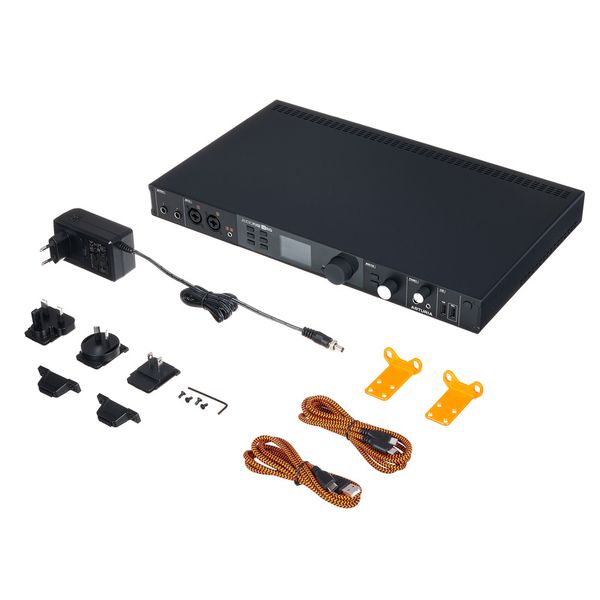
- Contents of the delivery: Quick start guide, power cable, USB-C to USB-C cable, USB-C to USB-A cable, registration card as well as detachable rack ears for rack mounting
Analogue inputs:
- Two Mic / Line / Instrument combo inputs: XLR / 6.3 mm jack
- 16 individually switchable line inputs (+4 dBu / -10 dBv): 6.3 mm TRS jack
- One stereo line input: 3.5 mm jack
Analogue outputs:
- Eight DC-coupled line outputs: 6.3 mm TRS jack
- Two monitor outputs: 6.3 mm TRS jack - front mirrored: Outputs 3 and 4
- One headphone output: 6.3 mm TRS jack
- One headphone output: 3.5 mm jack
Digital inputs/outputs:
- Dual ADAT I/O for up to 16 channels I/O at 48 kHz: 2x input / 2x output
- Word Clock I/O: BNC
- One MIDI-In/Out/Thru: 5-pin DIN
- One MIDI Clock-Out: 3.5 mm jack
- One MIDI host USB port on the front for USB MIDI controllers
-
Available since October 2023
-
Item number 577287
-
Sales Unit 1 piece(s)
-
Recording / Playback Channels 16x12
-
Number of Mic Inputs 2
-
Number of Line Inputs 18
-
Instrument Inputs 16
-
Number of Line Outs 12
-
Headphone Outs 2
-
Phantom Power Yes
-
Number of S/PDIF Connectors 0
-
Numer of AES/EBU Connectors 0
-
Number of MADI Connectors 0
-
Ethernet 0
-
Other Connectors USB-C
-
MIDI interface Yes
-
Word Clock 1xIn, 1xOut
-
Max. Sampling Rate in kHz 192 kHz
-
Max. Resolution Rate in Bits 24 bit
-
USB Bus-Powered No
-
Incl. power supply Yes
-
USB Version 2.0
-
Width 440 mm
-
Depth 260 mm
-
Height 45 mm
-
Connection Format USB port Type C, 3x Type A
-
Amount Of Channels 16
-
AD Conversion Yes
-
DA Conversion Yes
-
ADAT Yes
-
Word clock Yes
-
Number of analog inputs 16
-
Number of Analog Outputs 12
-
Headphone connection Yes
-
Special Features 16 analog Input Channels and 12 analog Output Channels; ADAT In / Out; MIDI In / Thru / Out
-
Included in delivery Power Supply, USB-C Cable, USB-A to USB-C Cable, Rack Mount Accessories
-
Zero latency monitoring Yes
-
Modular and hybrid studio command centre
The Arturia AudioFuse 16Rig is a high-performance USB-C interface that connects, manages, and synchronises complex electronic and hybrid studio setups within a single 1U rack unit. It features sixteen analogue line inputs (two of which include premium DiscretePRO mic preamps), twelve analogue outputs, dual ADAT I/O supporting up to sixteen digital channels, word clock synchronisation, and extensive MIDI routing functionalities. Also, eight DC-coupled rear-panel outputs generate control voltages (CV) for modular analogue synthesizers and other voltage-controlled hardware. High-resolution AD/DA converters ensure signal integrity and pristine audio capture, while the MIDI matrix, dual internal mixer architecture, and comprehensive software ecosystem – including studio-grade sounds and effects drawn from Arturia's catalogue – allow signals to be freely routed between hardware and software environments for processing and recording, offering a uniquely flexible workflow for electronic producers.
Hands-on signal management
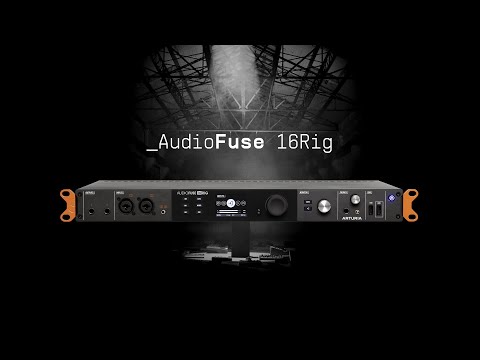
Beyond its focus on electronic production workflows, the Arturia AudioFuse 16Rig is also a capable recording front end, with essential features accessible on the well-organised front panel. Two pristine DiscretePRO preamps with switchable 48V phantom power and generous clean gain allow microphones, instruments, or DI sources to be captured at 24-bit/192kHz on the fly, while all sixteen line inputs remain available for large synthesizer rigs, mixers, and external processors. Clear controls and a crisp display enable straightforward gain staging, input configuration, and monitoring without diving into software menus. The eight rear DC-coupled outputs can carry audio signals or generate control voltages (CV) and gate signals for modular systems, while the word clock I/O maintains stable synchronisation across complex setups.
)
Routing and standalone operation
The sophisticated dual-mixer architecture at the core of the AudioFuse 16Rig supports both flexible DAW integration and true standalone operation. Separate Main and Cue mixers allow parallel configurations to serve different purposes, such as playback/monitoring mixes when tracking a live source, or troubleshooting a complex rig during a performance without affecting the main output. Routing options can be selected directly from the front panel via the display and rotary encoders, while deeper system configuration is accessed via the AudioFuse Control Center software when needed. An internal MIDI patchbay allows controllers, synths, and external devices to communicate independently of a DAW, allowing the AudioFuse 16Rig to pilot complete electronic systems alongside standard audio duties.
)
Immersive workflows
AudioFuse 16Rig adapts easily to demanding hybrid setups, whether managing a studio full of hardware synthesizers, configuring a recording and monitoring environment, or piloting a live hardware rig. Signals can be freely routed across analogue, digital, and CV domains via the internal routing matrix, building complex effects chains, parallel processing paths, or custom monitoring mixes and recording routes. Immersive audio scenarios – from surround sound configurations to artistic installations – can be precisely calibrated thanks to the flexible output architecture, with level control and speaker management handled directly from the interface. The combination of deep routing flexibility, DC-coupled outputs for CV/Gate control, and full standalone operation allows musicians and producers to shift fluidly between DAW workflows, hardware sequencing, and modular synth setups.
)
About Arturia
Arturia's success story began with software emulations of well-known analogue synthesizers such as the Moog Minimoog, Sequential Prophet-5, and Oberheim SEM. The popular software instruments included in the V Collection are still flagship products of the French developer today. Over time, Arturia has gradually expanded its range and now also offers a host of hardware devices, ranging from synthesizers and keyboard controllers to sequencers. Since then, the former software developer has thus also become a household name in the world of analogue synthesizers and other equipment.
Production software ecosystem
Arturia's AudioFuse 16Rig is supported by an extensive software package that complements its hardware-focused design and hybrid studio workflow. The AudioFuse Creative Suite includes a curated collection of Arturia effects inspired by classic studio hardware (such as Pre 1973, Pre V76, Pre TridA, Comp FET-76, Rev PLATE-140, Delay TAPE-201, Chorus JUN-6, Filter MINI, and Phaser BI-TRON) providing high-quality processing directly within the DAW environment. Analog Lab Intro provides a broad palette of synthesizer and keyboard sounds drawn from Arturia's V Collection. Alongside the AudioFuse Control Center, this ecosystem elevates the AudioFuse 16Rig's hybrid studio concept beyond immaculate audio capture, allowing projects to move seamlessly between hardware and software environments, whether mixing, sound designing, or recording. As bundled software may evolve, the manufacturer's website should be consulted for current details.
