


Yamaha URX44V BK



4-Channel USB 2.0 Audio Interface
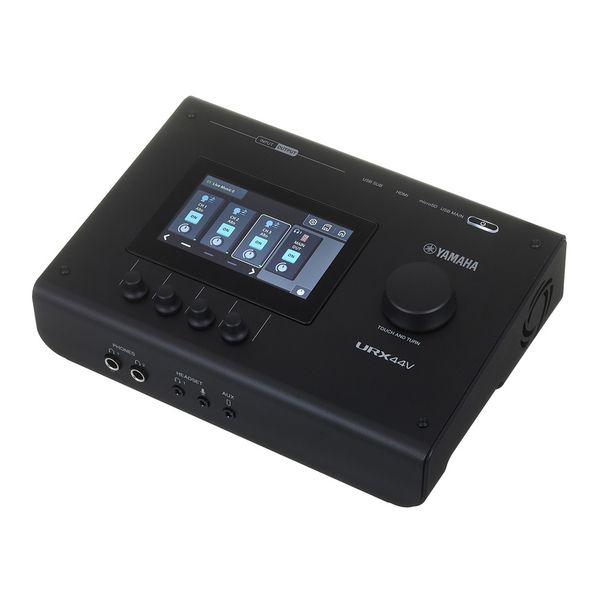
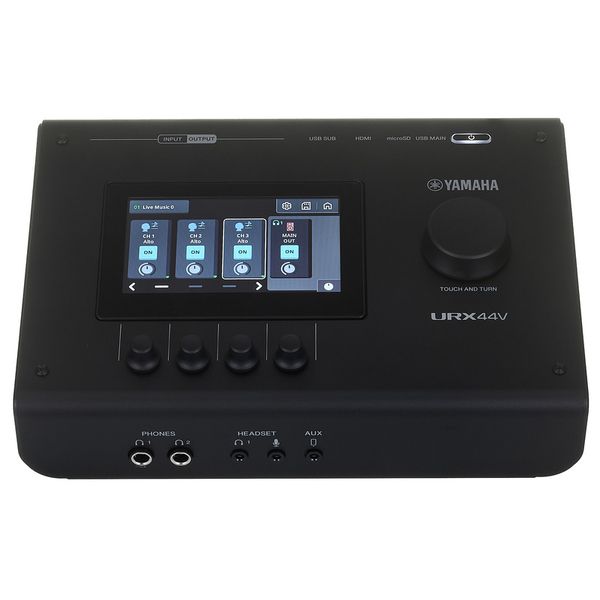
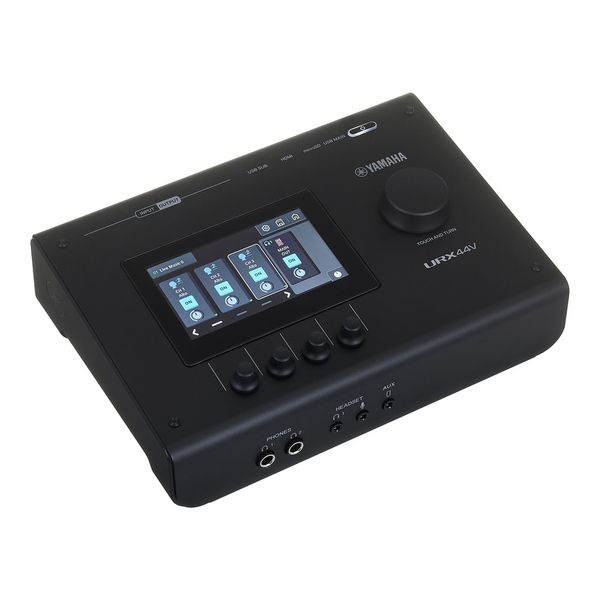
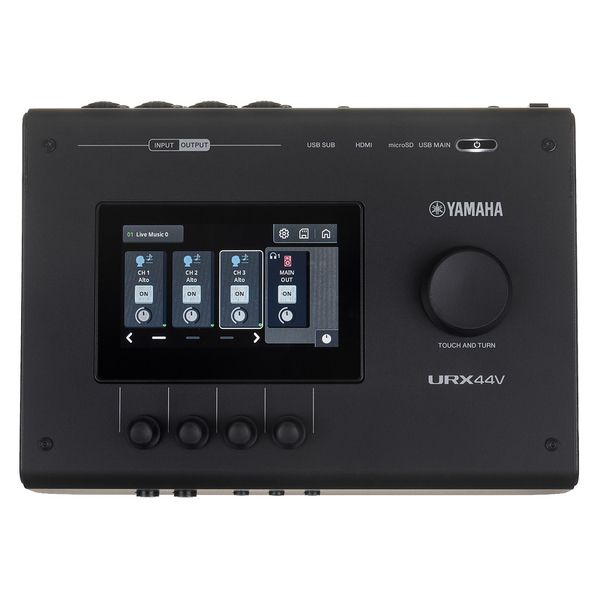
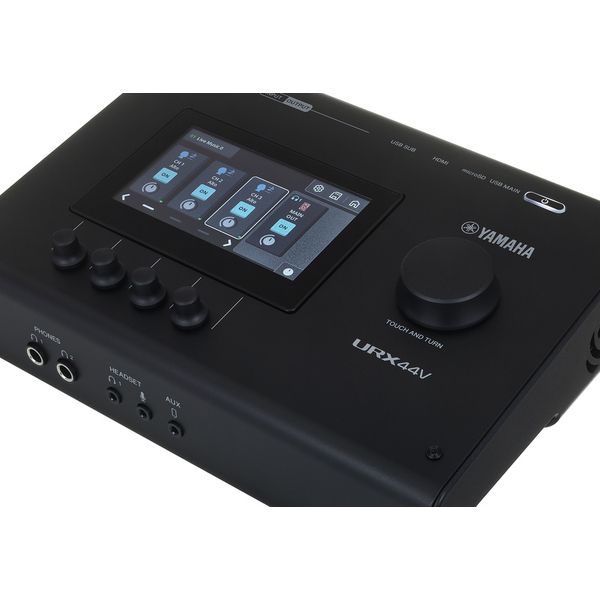
- With 4.3" touch screen
- 32 bit / 44.1 - 192 kHz
- Four rotary controllers under the display and a large "Touch & Turn" rotary controller
- Built-in DSP
- +48 V phantom power
- microSD card slot for up to 16-track recording and 2-track playback
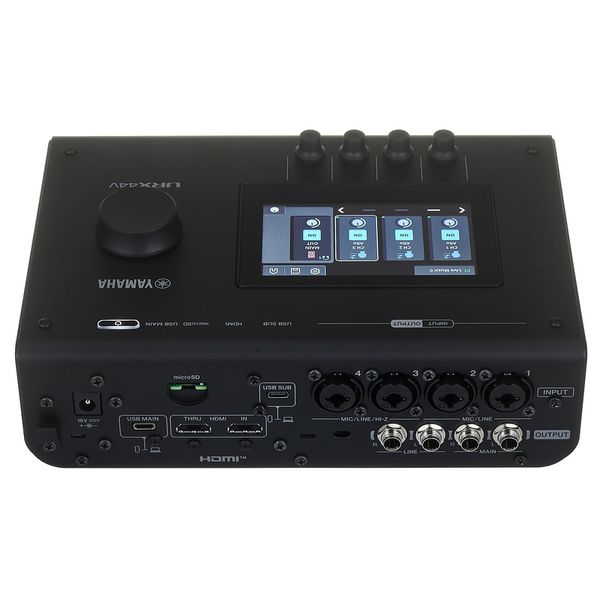
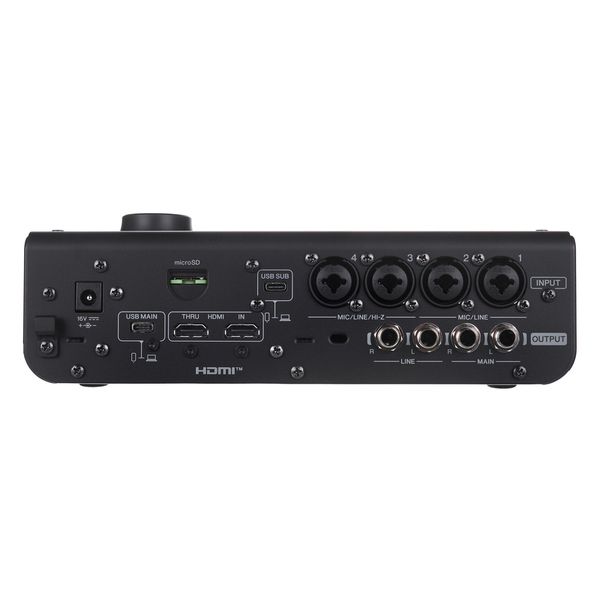
- HDMI for connecting external video devices such as cameras or game consoles to receive audio and video signals
- Four microphone/line combo inputs: XLR/6.3 mm jack (inputs 3 + 4 can be used as Hi-Z instrument inputs)
- Four line outputs: 6.3 mm jack
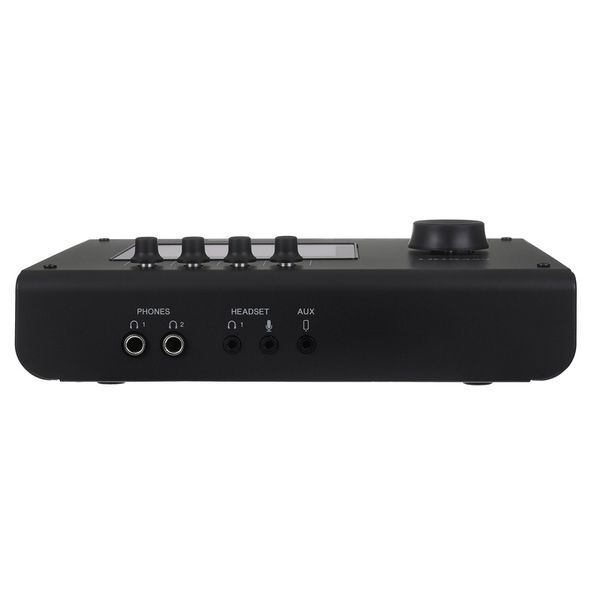
- Two stereo headphone outputs: 6.3 mm jack
- One headset connector with microphone input: 3.5 mm mini jack
- One headphone output: 3.5 mm mini jack stereo
- One aux input: 3.5 mm mini jack stereo
- One HDMI input / THRU (audio/video input/capture/pass-through)
- Two USB-C ports (data)
- Input for external power supply
- Dimensions (W × H × D): 245 × 78 × 182 mm
- Weight: 2 kg
- Colour: Black
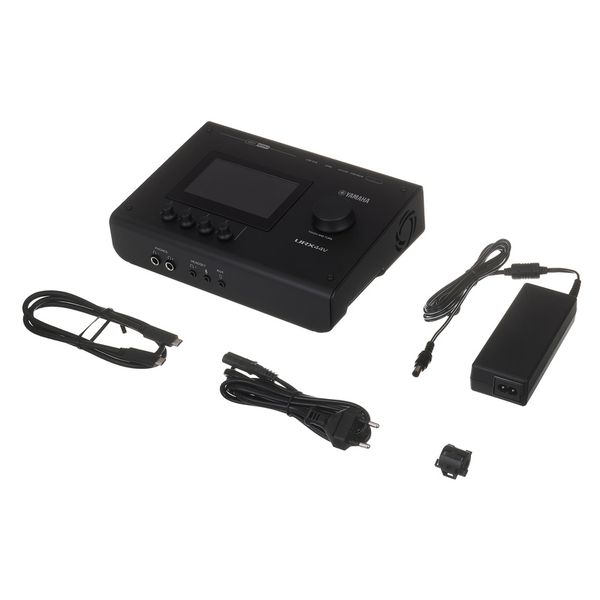
- Includes Cubase AI + WaveLab Cast, Steinberg Plus and USB 3.2 cable (Type-C to Type-C, 1.0 m) as well as external power supply DC16 V / 2.4 A.
PA-300C
-
Available since January 2026
-
Item number 634402
-
Sales Unit 1 piece(s)
-
Recording / Playback Channels 4x4
-
Number of Mic Inputs 4
-
Number of Line Inputs 4
-
Instrument Inputs 2
-
Number of Line Outs 4
-
Headphone Outs 2
-
Phantom Power Yes
-
Number of S/PDIF Connectors 0
-
Number of ADAT Connectors 0
-
Numer of AES/EBU Connectors 0
-
Number of MADI Connectors 0
-
Ethernet 0
-
Other Connectors HDMI
-
MIDI interface No
-
Word Clock No
-
Max. Sampling Rate in kHz 192 kHz
-
Max. Resolution Rate in Bits 32 bit
-
USB Bus-Powered No
-
Incl. power supply Yes
-
USB Version 2.0
-
Width 245 mm
-
Depth 182 mm
-
Height 78 mm
-
Connection Format USB port Type C
-
Included in delivery Power Supply, Power Cable, USB-C Cable
-
Zero latency monitoring Yes
-

One interface, every workflow
The Yamaha URX44V is a portable and versatile audio interface designed for musicians, streamers, video content creators, and live presenters – combining high-quality recording, onboard DSP processing, flexible hands-on control, and integrated HDMI connectivity. At the front end, it features four high-quality mic preamps on combo XLR inputs (including two Hi-Z instrument inputs), high-resolution AD/DA conversion, and a comprehensive DSP system with per-channel processing, internal effects including ducking, and an internal mixer. All parameters can be adjusted via the prominent 4.3" touchscreen and five encoders, providing immediate access to routing, processing, and system settings without relying on external software. This allows the URX44V to adapt quickly to complex workflows involving multiple sources – from DAW-based recording and small ensemble setups to live streaming and integrated AV production – with preset configurations supporting fast transitions between applications.

)
True Sound and touchscreen
The URX44V is equipped with four mic preamps based on Yamaha's True Sound philosophy, offering low-noise, low-distortion signal capture with a dynamic range of up to 115dB, supported by high-resolution 32-bit/192kHz conversion. Gain is set directly via the rotary controls, while the onboard DSP provides real-time processing on each input channel – including gate, compression, and EQ – allowing signals to be shaped at source for recording or broadcast. Internal effects include pitch correction, amp simulation, and reverb, with all parameters accessible via the encoders or touchscreen, supporting both quick adjustments and precise fine-tuning. Processed signals can be monitored directly and routed to the main or headphone mixes, while the built-in microSD recorder provides a direct option for 16-track capture or backup – allowing the URX44V to operate as a self-contained processing, mixing, and recording front end.
)
From bedroom to broadcast
Beyond the obvious use cases of singer-songwriters and content creators, the Yamaha URX44V will appeal to anyone working regularly with audio and video – live streamers, video journalists, hybrid event presenters, and multi-source podcasters among them. A front-panel headset input/output further supports communication-based workflows. Integrated assistive tools such as auto gain, ducking, and preset recall simplify common production tasks, reducing setup time and keeping the focus on performance and content. The clearly structured interface supports both quick operation and more detailed adjustment, while Simple Mode provides a streamlined entry point for less experienced users. In dynamic environments such as live presentations, interviews, or streaming setups, the URX44V maintains stable and predictable operation, with integrated delay allowing precise compensation for audio latency when working alongside video.
)
About Yamaha
For decades, Yamaha has been one of the world's best-known manufacturers of musical instruments and audio technology. The Japanese company's long history began at the end of the 19th century with the harmonium. The product range has constantly expanded since then, which has made Yamaha one of the few manufacturers today to offer almost the entire range of existing musical instruments: From upright and grand pianos to guitars, wind instruments, and bowed string instruments and from drums and percussion to electronic keyboards and synthesizers. Yamaha is also a major force in the field of audio engineering as a manufacturer of mixing consoles, amplifiers, PA systems, and more. Yamaha's guiding principle is to combine traditional craftsmanship with state-of-the-art technology.
Seamless integration
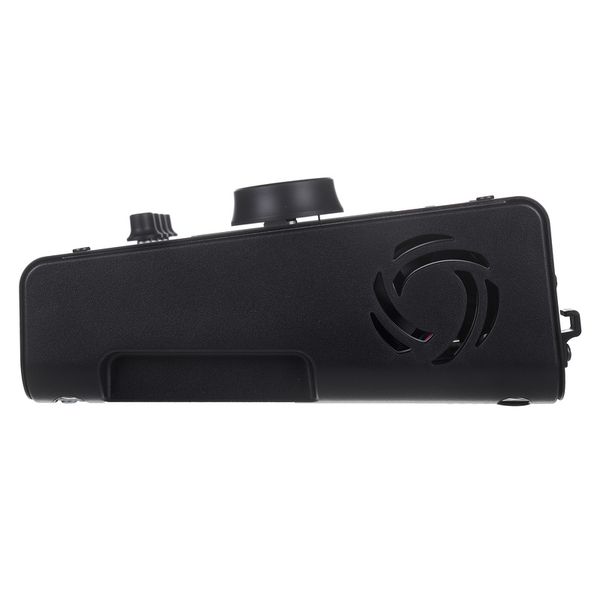
Compatible with OBS Studio, Elgato Stream Deck, and similar production tools, the Yamaha URX44V integrates cleanly into existing workflows. Its dual USB architecture allows flexible routing: the MAIN connection supports up to 18 channels of recording and playback, while the SUB USB port provides an additional 2-channel path for streaming, backup recording, or external playback, and an auxiliary input allows external audio sources to be brought into the mix when required. Four balanced outputs feed desks, interfaces, or outboard gear, while the built-in microSD recorder offers a reliable standalone capture option – ideal for live situations or as a safety net alongside a DAW. Essential connectivity is well covered, with 48V phantom power, two Hi-Z instrument inputs, dual headphone outputs, and HDMI input and pass-through for integrated AV workflows. The robust all-metal chassis and high-quality controls mean the URX44V travels as well as it performs – equally at home on a studio desk, a conference room setup, or a mobile rig.
In the spotlight
URX44V HDMI connectivity
The URX44V adds integrated HDMI connectivity, with both an input and pass-through allowing video signals to be routed alongside audio within a single device. In practice, a camera or computer can be connected directly, with video transmitted in real time while processed audio is combined into a single AV stream over USB. When used with streaming or recording software, the URX44V functions as both a full-featured audio interface and a video capture bridge – consolidating what would otherwise require separate devices into a single, portable unit. The core DSP architecture and control workflow remain identical to those of the URX44, making the URX44V the natural choice for anyone whose work sits at the intersection of audio and video production.
)
Accessories & matching items


Compare options
-
Yamaha USB Audio Interfaces at a glance
-
Display USB Audio Interfaces from £ 500 - £ 1000
-
Go to product group USB Audio Interfaces
-
Go to product group Audio Interfaces
-
Go to product group Studio and Recording Equipment
-
Show manufacturer details for Yamaha
-
Yamaha Studio and Recording Equipment at a glance