


P
Saturation baby!
This is a pedal you didn't know you needed , until you get it.
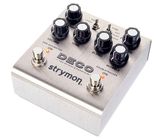
The saturation gives you a beautiful warm fat tone. The new cassette setting is great and adds a more compressed saturation. I wasn't sure how different this would be but I prefer it to the standard setting. The addition of the tone control is really helpful and can brighten up a dark amp or other pedals.
The double tracking side is way more flexible then it looks. The type, lag, wobble and blend all interact to give a wide variety of sounds. I'm using midi to switch between Flanger, chorus and a nice warm basic delay that I've set up as presets. I've left the saturation always on and bring in the double tracker side as needed.
The V2 version is more expensive and I did consider the V1 to save some money but on balance the MIDI, tone control and the improved JFET inputs are more than worth the extra €.
In conclusion I love this pedal. It's given my sound a warmth and a lovely soft overdrive I couldn't get with anything else.
The saturation gives you a beautiful warm fat tone. The new cassette setting is great and adds a more compressed saturation. I wasn't sure how different this would be but I prefer it to the standard setting. The addition of the tone control is really helpful and can brighten up a dark amp or other pedals.
The double tracking side is way more flexible then it looks. The type, lag, wobble and blend all interact to give a wide variety of sounds. I'm using midi to switch between Flanger, chorus and a nice warm basic delay that I've set up as presets. I've left the saturation always on and bring in the double tracker side as needed.
The V2 version is more expensive and I did consider the V1 to save some money but on balance the MIDI, tone control and the improved JFET inputs are more than worth the extra €.
In conclusion I love this pedal. It's given my sound a warmth and a lovely soft overdrive I couldn't get with anything else.
12
1
Report
P
Great for synths, and a very useful multi-purpose tool across other instruments
I am a hobby musician who likes to play various instruments. I bought the Strymon Deco v2 alongside a digital synthesizer. At the time, the decision was based on a plethora of positive online reviews, which overwhelmingly state that this pedal: 1) Gives a warm and thickened tone, and 2) Is compatible with line-level signals outputted by synths.
When I connect the pedal to the synth, this pedal delivers exactly what I had hoped for. In my hands, the left side (tape saturation) behaves like a 'Warm Saturator' between roughly 0-50%, and then between 50-100% a more noticeable compression/distortion is introduced. The volume knob is very convenient, and the tone knob is subtle but useful.
The right side (doubletracker) has a deeper functionality then I first expected. I use it for four different time-based effects, depending on the position of the 'Lag Time' knob. I would estimate that set between 0-30% it is a flange, between 30-60% a chorus, between 60-70% a slapback, then between 70-100% a delay. That delay is either a single echo (sum mode) or double echo (bounce mode). The blend knob functions nicely, and the wobble seems to introduce detune in the form of combined wow+flutter.
I was very positively surprised when I later used this pedal across various other instruments. One useful feature is the 'headroom adjustment' secondary function, which changes the amount of headroom between line-level versus instrument-level. This makes the pedal versatile across instruments.
For bass guitar, I really like using this pedal. I generally set 'Tape Saturation' to medium and 'Tone' to low. I leave the doubletracker off. Somehow, this makes the bass more noticeable in the mix, without needing extra volume. For example, when holding sustained notes on the bass, they seem to ring-out in a pleasant way, with less muddiness. This is useful in a band setting.
On electric guitar, the usefulness of the tape saturation side is probably a matter of taste (I would vaguely describe it as a warm saturation which fits for many genres, but if you want heavy distortion you will be disappointed). The doubletracker side seems to fit nicely to electric guitar, in particular the slapback as 'tone thickener'.
A note on the flange: I really like the flange delivered by this pedal! This is partly because the blend and wobble knobs give good adjustability of the flange intensity. But mainly, this is because the architecture of the doubletracker side enables a 'through-zero' flange effect. I might be wrong here, but as I understand, this pedal does not have a 'wet/dry' blend. Instead, it blends together two processed channels. Therefore, it is possible to set the time offset of the lag deck 'ahead' of the reference deck (ie: negative time delay). Then the user can sweep the lag time knob, such that the lag deck goes ahead or behind the reference deck, giving a through-zero effect. (Note: I am not a professional and I might be wrong about this).
The pedal can also be used as a stereo splitter (mono-in, stereo-out) via a secondary function. This works nicely, and there is some flexibility with the outputted stereo signal (eg: pan, detune on R channel, ping-pong double repeat delay).
When I connect the pedal to the synth, this pedal delivers exactly what I had hoped for. In my hands, the left side (tape saturation) behaves like a 'Warm Saturator' between roughly 0-50%, and then between 50-100% a more noticeable compression/distortion is introduced. The volume knob is very convenient, and the tone knob is subtle but useful.
The right side (doubletracker) has a deeper functionality then I first expected. I use it for four different time-based effects, depending on the position of the 'Lag Time' knob. I would estimate that set between 0-30% it is a flange, between 30-60% a chorus, between 60-70% a slapback, then between 70-100% a delay. That delay is either a single echo (sum mode) or double echo (bounce mode). The blend knob functions nicely, and the wobble seems to introduce detune in the form of combined wow+flutter.
I was very positively surprised when I later used this pedal across various other instruments. One useful feature is the 'headroom adjustment' secondary function, which changes the amount of headroom between line-level versus instrument-level. This makes the pedal versatile across instruments.
For bass guitar, I really like using this pedal. I generally set 'Tape Saturation' to medium and 'Tone' to low. I leave the doubletracker off. Somehow, this makes the bass more noticeable in the mix, without needing extra volume. For example, when holding sustained notes on the bass, they seem to ring-out in a pleasant way, with less muddiness. This is useful in a band setting.
On electric guitar, the usefulness of the tape saturation side is probably a matter of taste (I would vaguely describe it as a warm saturation which fits for many genres, but if you want heavy distortion you will be disappointed). The doubletracker side seems to fit nicely to electric guitar, in particular the slapback as 'tone thickener'.
A note on the flange: I really like the flange delivered by this pedal! This is partly because the blend and wobble knobs give good adjustability of the flange intensity. But mainly, this is because the architecture of the doubletracker side enables a 'through-zero' flange effect. I might be wrong here, but as I understand, this pedal does not have a 'wet/dry' blend. Instead, it blends together two processed channels. Therefore, it is possible to set the time offset of the lag deck 'ahead' of the reference deck (ie: negative time delay). Then the user can sweep the lag time knob, such that the lag deck goes ahead or behind the reference deck, giving a through-zero effect. (Note: I am not a professional and I might be wrong about this).
The pedal can also be used as a stereo splitter (mono-in, stereo-out) via a secondary function. This works nicely, and there is some flexibility with the outputted stereo signal (eg: pan, detune on R channel, ping-pong double repeat delay).
5
0
Report
y
A Must Have!
Although it is a double tracker pedal you may consider it as a fabulous natural tube overdrive thanks to saturation side. Great companion for jazzmaster clean tones, excellent for lo fi and shoe gaze. Outstanding slapback echo.
4
0
Report
F
TOP
Gebruik het voor keys, super!
1
1
Report
KM
Best at its class!
The crown jewel of tape saturators / harmonic overdrives.
It perfectly emulates chorus, flanger, phaser, tape echo, tape compression and modulation.
However, its the harmonic overtones this unit produces in regard to tape-saturation, that makes the "Deco" indispensable to any modern high-quality audio application.
This pedal works like a charm on any audio signal from synthesizers to mastering rigs and anything inbetween, adding immersive analog warmth and exceptional tonal character.
In serial or pararel mode this is a one-stop "beautify" audio tool!
It perfectly emulates chorus, flanger, phaser, tape echo, tape compression and modulation.
However, its the harmonic overtones this unit produces in regard to tape-saturation, that makes the "Deco" indispensable to any modern high-quality audio application.
This pedal works like a charm on any audio signal from synthesizers to mastering rigs and anything inbetween, adding immersive analog warmth and exceptional tonal character.
In serial or pararel mode this is a one-stop "beautify" audio tool!
0
0
Report
SB
Strymon Deco v2
The glorious sound, now with all the practicalities that the v1 was missing... and more
0
0
Report