


SR
Good but not for me!
First things first: as always, Thomann’s delivery and return service have been exceptional.
Having mentioned that I returned the product, I still want to make it clear that I’m a huge fan of Boss products. 6 of the 11 pedals on my pedalboard are Boss.
That said, I’ll get straight to the point with my review:
What I liked:
- The sturdy build quality we’ve come to expect from Boss.
- It includes a power adapter that helps reduce “noise” from poor grounding.
- The amp simulations are sufficient to cover all needs: electric guitar, acoustic guitar, and bass.
- The stereo FX loop is probably what I liked most about the pedal, and that’s why I bought it. I wanted to run my modulation and delay effects in stereo.
What I didn't like:
- You have to buy the cable to connect to the computer separately, even though it's essential for loading the IRs. On top of that, the required cable isn't even a Type-C cable, which I'm sure we all have one of at home.
- It has a huge number of IRs and microphone types, but when I loaded external IRs from YA, I realized that the factory-installed ones don’t sound that great after all.
- Even after loading external IRs, it took me many hours to achieve the sound I was looking for. Cheaper devices are easier to work with in that regard—you can find a decent sound in no time. Then, when you switch to a different type of guitar, all that work goes down the drain because you have to reconfigure everything because of compression and dynamics. Of course, you can create different patches for that, but my goal isn’t to use ten patches—I just want one or two that’ll work for everything.
- The simulator handles external pedals well, but man, it’s a real struggle to get the overdrives and distortions to sound good. They have a certain “harshness” that can be very unpleasant, and to round the sound, I had to use the parametric EQ, which took me more time.
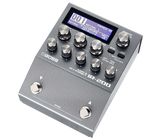
In short, I feel that due to the proliferation of so many amp simulator products, the IR 200 has fallen behind or become outdated. Maybe my perception would be different if I’d bought it four years ago. Ultimately, it’s just my opinion, maybe it just wasn’t for me; the best way to form your own judgment is to try it out for yourself, you may actually like it!
Having mentioned that I returned the product, I still want to make it clear that I’m a huge fan of Boss products. 6 of the 11 pedals on my pedalboard are Boss.
That said, I’ll get straight to the point with my review:
What I liked:
- The sturdy build quality we’ve come to expect from Boss.
- It includes a power adapter that helps reduce “noise” from poor grounding.
- The amp simulations are sufficient to cover all needs: electric guitar, acoustic guitar, and bass.
- The stereo FX loop is probably what I liked most about the pedal, and that’s why I bought it. I wanted to run my modulation and delay effects in stereo.
What I didn't like:
- You have to buy the cable to connect to the computer separately, even though it's essential for loading the IRs. On top of that, the required cable isn't even a Type-C cable, which I'm sure we all have one of at home.
- It has a huge number of IRs and microphone types, but when I loaded external IRs from YA, I realized that the factory-installed ones don’t sound that great after all.
- Even after loading external IRs, it took me many hours to achieve the sound I was looking for. Cheaper devices are easier to work with in that regard—you can find a decent sound in no time. Then, when you switch to a different type of guitar, all that work goes down the drain because you have to reconfigure everything because of compression and dynamics. Of course, you can create different patches for that, but my goal isn’t to use ten patches—I just want one or two that’ll work for everything.
- The simulator handles external pedals well, but man, it’s a real struggle to get the overdrives and distortions to sound good. They have a certain “harshness” that can be very unpleasant, and to round the sound, I had to use the parametric EQ, which took me more time.
In short, I feel that due to the proliferation of so many amp simulator products, the IR 200 has fallen behind or become outdated. Maybe my perception would be different if I’d bought it four years ago. Ultimately, it’s just my opinion, maybe it just wasn’t for me; the best way to form your own judgment is to try it out for yourself, you may actually like it!
0
0
Report