


Arturia MiniFreak Vocoder




One month of full access to Syntorial for free – learn synth programming like a video game
When you purchase this product between 15.07.2026 and 15.10.2026, you receive a free 30-day full trial of Syntorial, the interactive ear-training software for synth programming.
Instead of just watching videos, you recreate leads, basses, pads and more. Get instant feedback as you learn how oscillators, filters, modulation and effects work together to create real patches.
Your personal voucher code will be sent automatically by e-mail after your order. No credit card required. The trial ends automatically after expiry.
This offer is available in English, French, Spanish, and Japanese.
Algorithmic Synthesizer
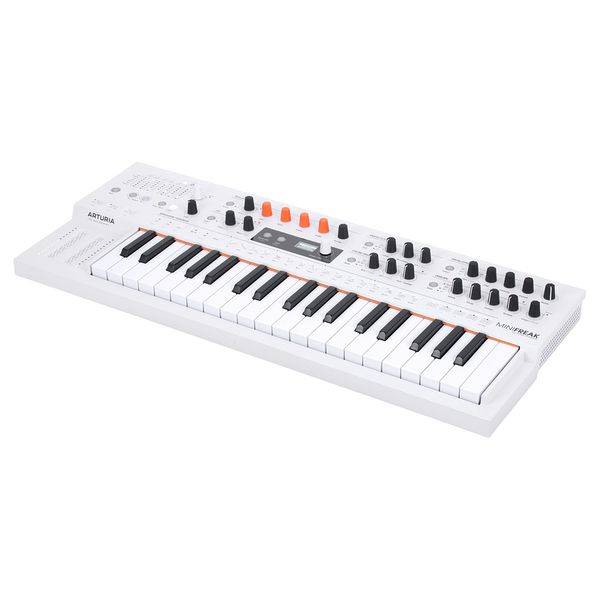
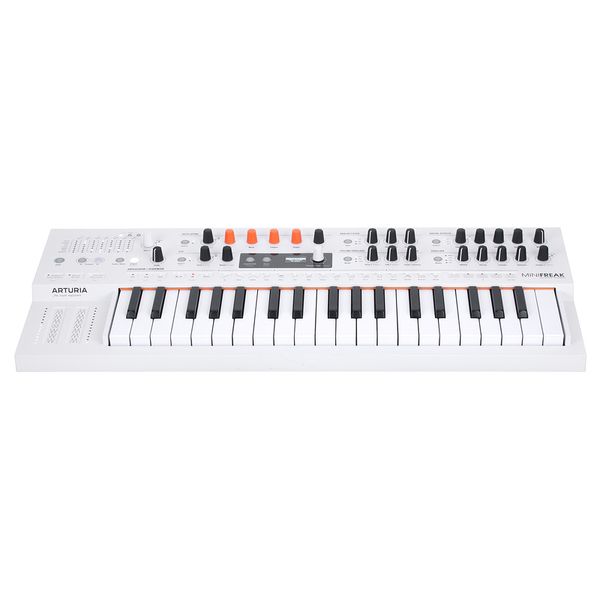
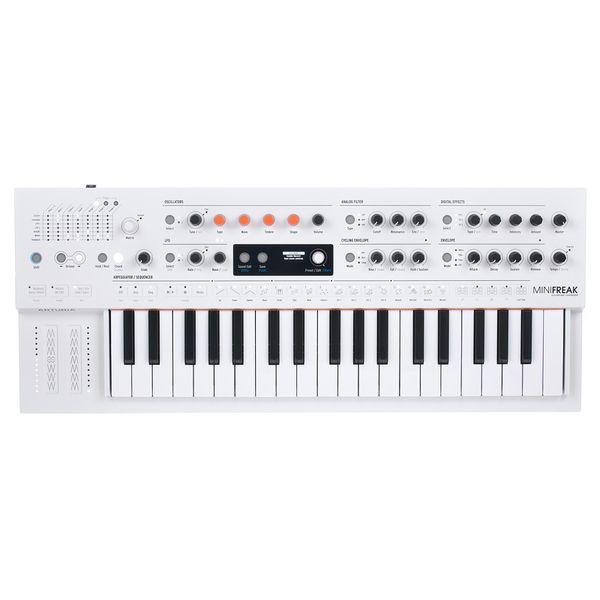
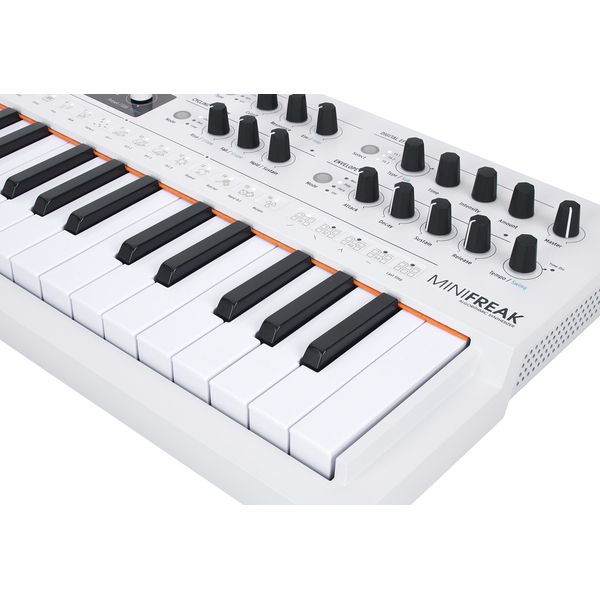
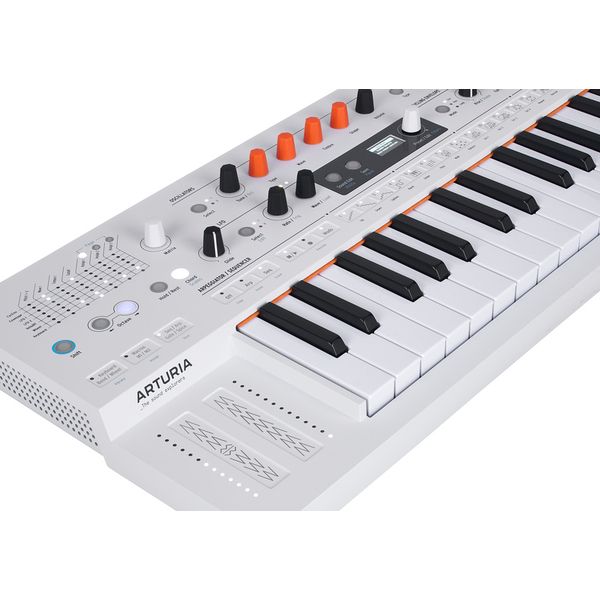
- 37 velocity-sensitive slim keys with aftertouch
- 6-voice polyphony
- 12-voice paraphony
- Unison and Mono modes
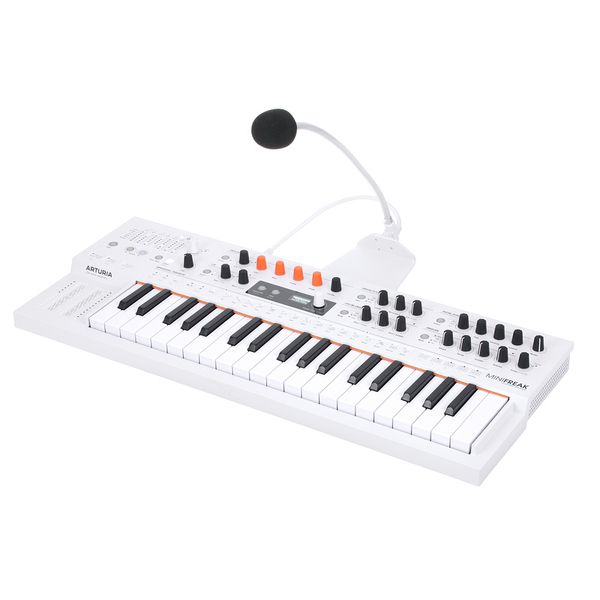
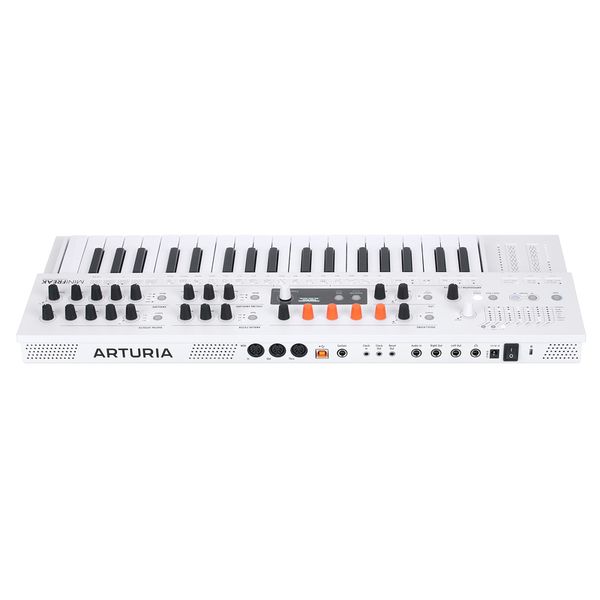
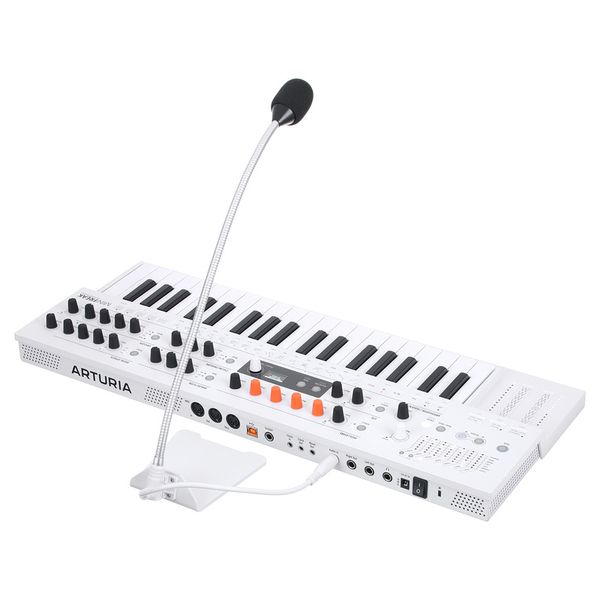
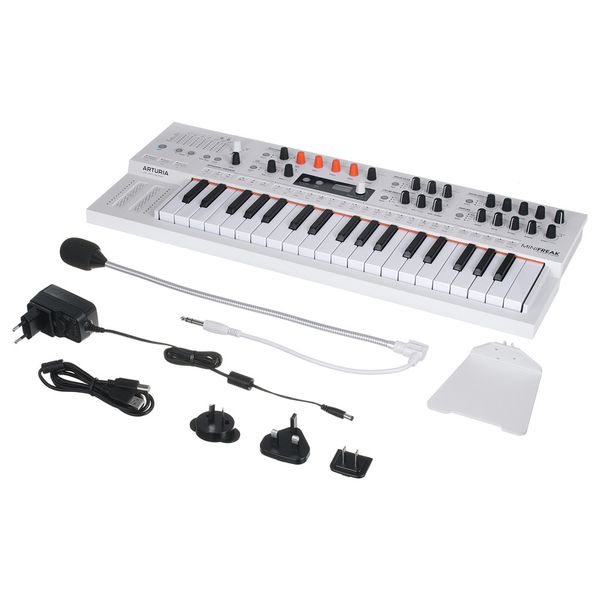
- 16-band vocoder with removable gooseneck microphone
- Two digital sound engines with over 30 selectable oscillator modes (Superwave, Wavetable, Karplus Strong, Noise, and more)
- Users can import their own samples and wavetables via MiniFreak V (firmware 5.0 or higher)
- Extensive modulation options including FM and ring modulation
- Per voice: ADSR envelope, multi-segment envelope/LFO, two LFOs, and analogue multimode filter (low-pass, band-pass, high-pass)
- Modulation matrix with 7 sources and 13 destinations
- 3 effect slots in insert or send mode, with 13 effects including Ext Vocoder and Self Vocoder
- Performance arpeggiator with ratcheting and random functions
- Step sequencer with 64 steps and 4 lanes of automated modulation
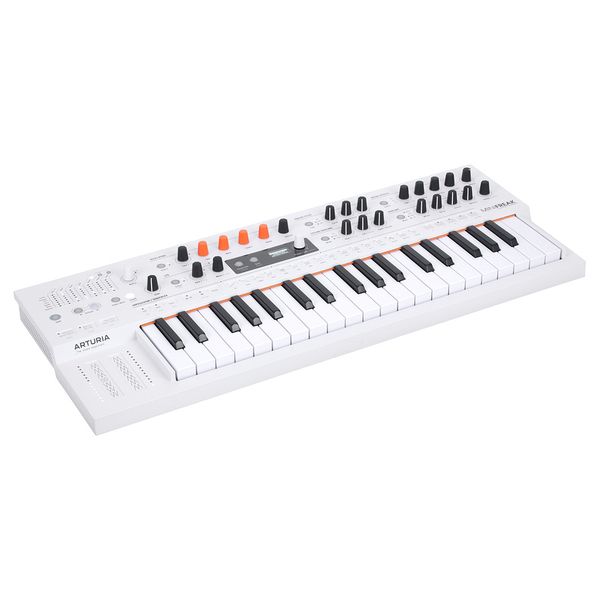
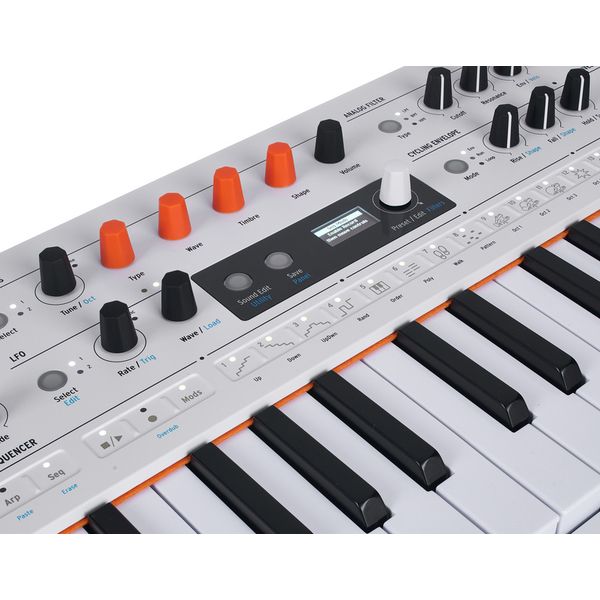
- Intuitive operation via OLED display and 40 rotary controls, encoders, and buttons
- 420 factory presets and 244 memory slots for user presets
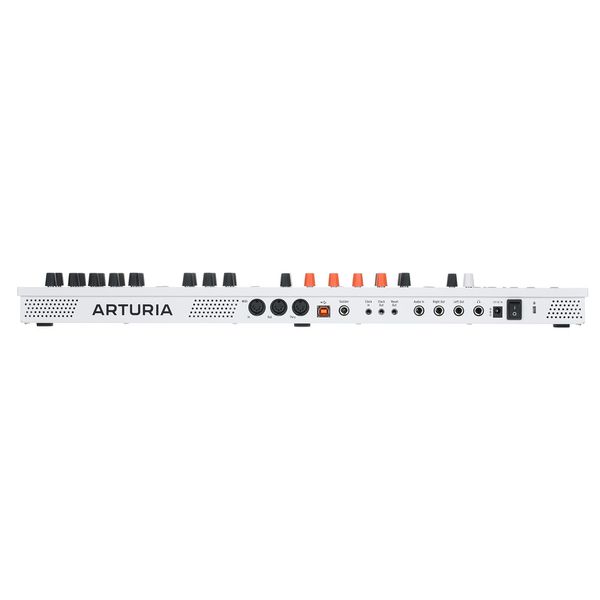
- Symmetrical stereo line outputs: 2 x 6.3 mm jack
- Line input: 6.3 mm jack
- Stereo headphone output: 6.3 mm jack
- Sustain pedal connection: 6.3 mm jack
- Clock input/output and reset output: 3.5 mm mini-jack
- MIDI In/Out/Thru: 5-pin DIN
- USB-B port
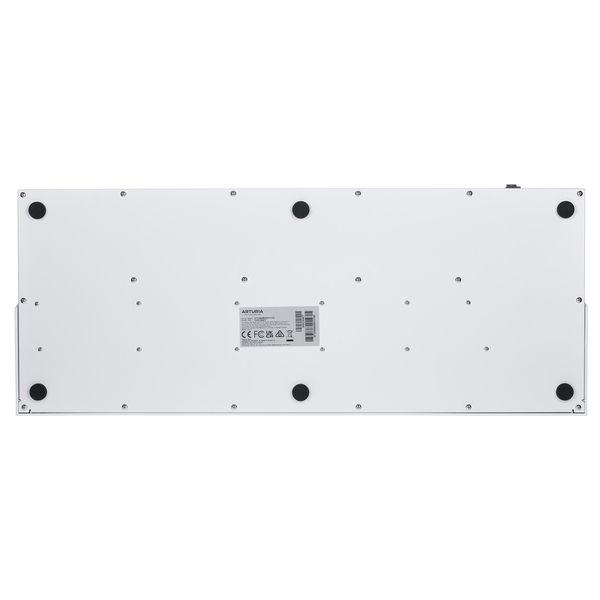
- Dimensions (W x D x H): 578 x 231 x 55 mm
- Weight: 3.28 kg
- Includes removable gooseneck microphone (30 cm) with stand, external power supply, USB-C to USB-A cable, and MiniFreak V software (download)
-
Available since June 2025
-
Item number 619121
-
Sales Unit 1 piece(s)
-
Number Of Keys 37
-
Touch-Sensitive Yes
-
Aftertouch Yes
-
Split Zones No
-
Modulation Wheel Yes
-
Number of simultaneous Voices 6
-
Sound Engine Digital Analog Hybrid
-
MIDI interface 1x In, 1x Out, 1x Thru
-
Storage Medium Internal
-
USB-port Yes
-
Effects Yes
-
Arpeggiator Yes
-
Number of Analog Outputs 2
-
Digital Output No
-
Display Yes
-
Pedal Connections 1x Sustain
-
Dimensions 578 x 231 x 55mm
-
Weight 3,3 kg
-
A hybrid synthesizer built for discovery
)
The Vocoder Edition of Arturia's MiniFreak is a six-voice polyphonic hybrid synthesizer combining dual digital sound engines, an analogue filtering stage, and a hands-on workflow tailored for live performance and sound design. The MiniFreak's multi-engine architecture – spanning subtractive synthesis, FM, wavetable synthesis, and modular-inspired algorithms – encourages sonic exploration from classic tones to experimental textures, while keeping the workflow clear and accessible. MIDI and analogue clock connectivity support integration with external hardware and DAWs, while the included MiniFreak V plug-in mirrors the hardware's architecture, as well as allowing users to import their own samples and sounds and even play them on the synth itself. This special edition ships in a dedicated white finish with a bundled gooseneck microphone, ready to put the MiniFreak's 16-band vocoder – available to all MiniFreak owners via free firmware – to use right out of the box.

)
Two engines, one vocoder
The Arturia MiniFreak’s sound engine centres on two digital sound engines per voice, offering a diverse palette of synthesis methods, including virtual analogue, FM, additive, granular, wavetable, and physical modelling – among them Karplus-Strong plucked string modelling and harmonic synthesis. These engines can run in parallel for layering or interact serially for dynamic processing, before the sound passes through per-voice analogue filters with low-pass, band-pass, and high-pass modes, adding warmth, resonance, and dynamic movement to the digital core. A flexible modulation system – with twin LFOs, a cycling envelope, custom LFO shaping, and a streamlined modulation matrix – keeps evolving textures and animated timbres intuitive to create. The result is a synthesizer equally capable of crystalline keys, lush pads, gnarly basses, and experimental textures that defy conventional categories.
)
Hands-on creation combined with organic performance
The MiniFreak’s interface is designed for immediate interaction rather than deep menu navigation. Sixteen step buttons above the keyboard provide control over the sequencer and arpeggiator, for programming and editing patterns in real time, customising LFO shapes, and modulating sequence parameters. Generative tools such as Spice & Dice introduce controlled randomness for evolving musical variations, while the two capacitive touch strips can function as pitch and modulation controls or shape multiple parameters with a single gesture. Chord and Scale modes support harmonic exploration, while the velocity-sensitive Slim-key keybed with aftertouch adds expressive control. Together, these features encourage sequences, textures, and timbres to develop organically through performance.
)
About Arturia
Arturia's success story began with software emulations of well-known analogue synthesizers such as the Moog Minimoog, Sequential Prophet-5, and Oberheim SEM. The popular software instruments included in the V Collection are still flagship products of the French developer today. Over time, Arturia has gradually expanded its range and now also offers a host of hardware devices, ranging from synthesizers and keyboard controllers to sequencers. Since then, the former software developer has thus also become a household name in the world of analogue synthesizers and other equipment.
Workflow and studio integration
The modulation matrix on the Arturia MiniFreak’s front panel keeps the patch architecture clearly visible, while dedicated control sections provide direct access to synthesis, filtering, envelopes, and effects. The dual engines feed the per-voice analogue filter, adding subtle coloration, resonant filtering, or full-blown distortion before reaching the stereo effects section. Three FX slots – including chorus, delay, reverb, distortion, compression, and vocoder modes – allow patches to be further refined and finalised in situ. An external audio input allows incoming sources to be processed through the filters and effects, including vocals for vocoder processing. Balanced stereo outputs, full MIDI connectivity, USB integration, and analogue clock I/O with sequencer reset output ensure reliable synchronisation with external hardware, modular setups, and DAW-based production environments.
In the spotlight
Vocoder FX
The hybrid architecture of Arturia's MiniFreak includes a 16-band vocoder integrated directly into the effects section, ready to use on the Vocoder Edition with the supplied gooseneck microphone, or with any external audio source. Incoming signals can be reshaped into classic robotic voices, spectral textures, and rhythmic vocal patterns, or applied internally to the synth's own engine for vocoded pads and evolving synthetic choirs without an external carrier. Multiple voicing modes – clean, vintage, narrow, gated – and flexible routing extend its range from rhythmic chops and harmonic textures to vintage-style robotic effects. More than a simple addition to the MiniFreak, the vocoder adds a new facet to the instrument’s hybrid identity.
)