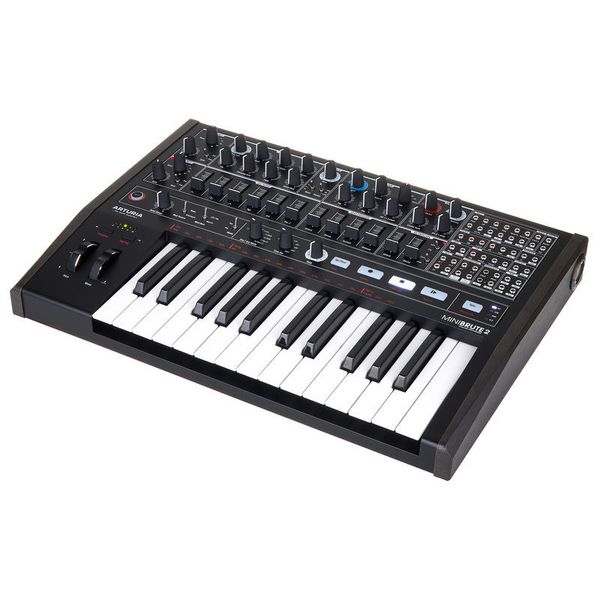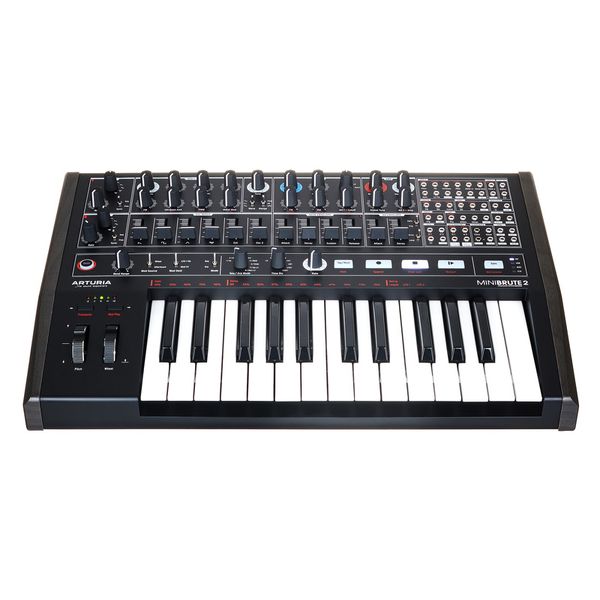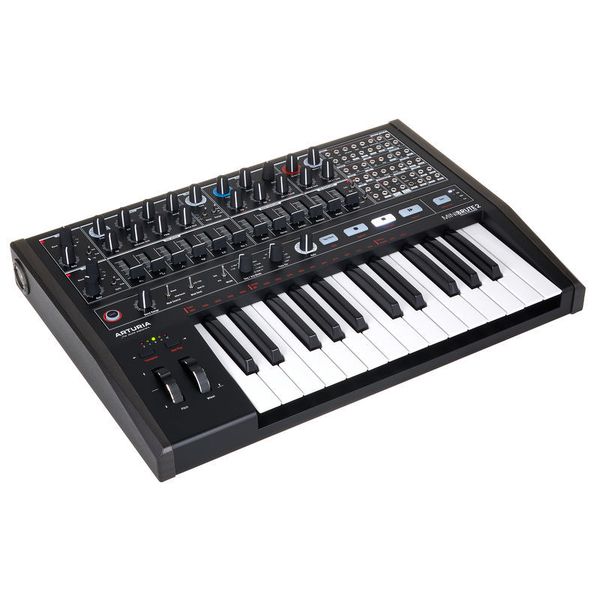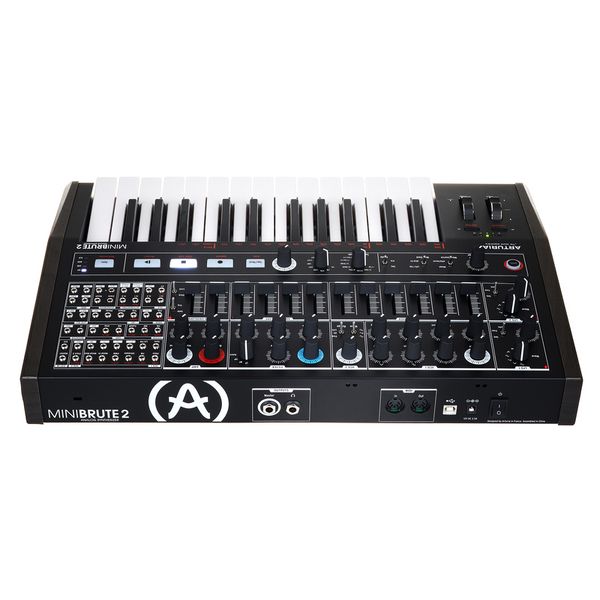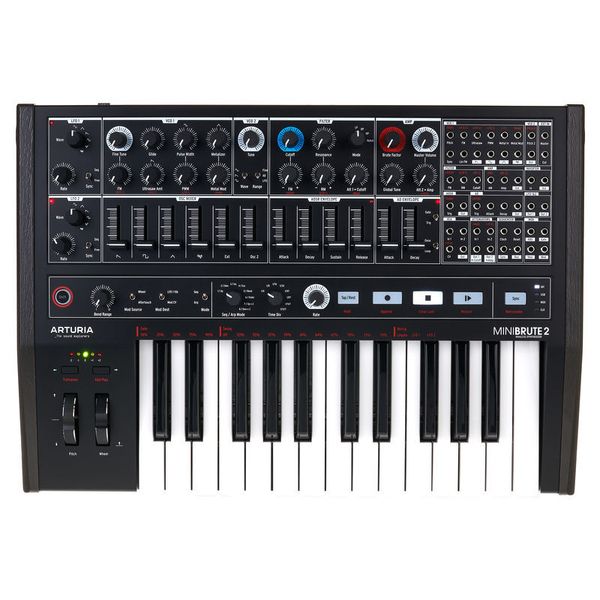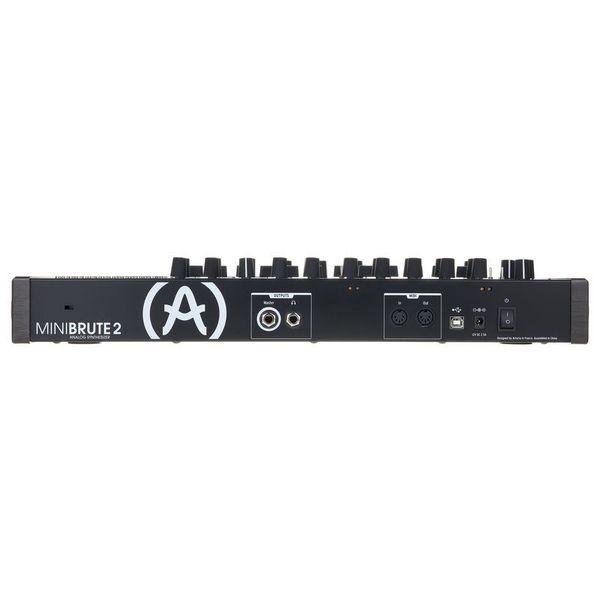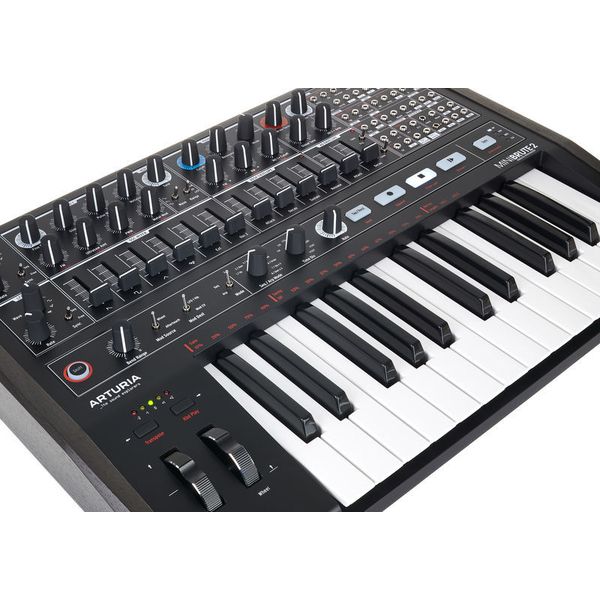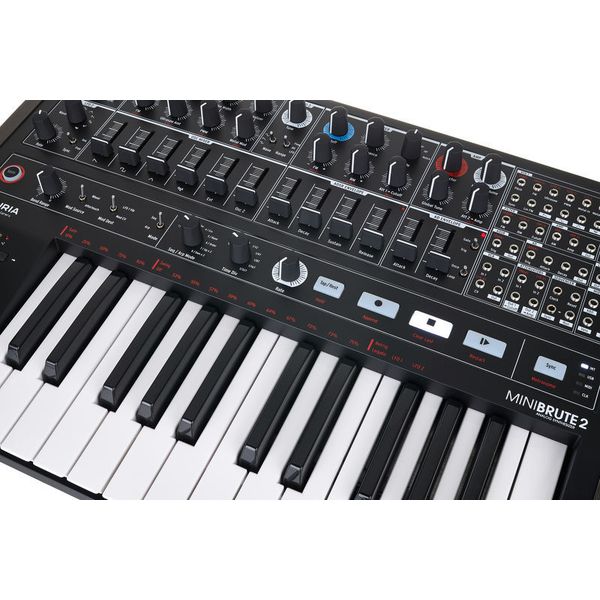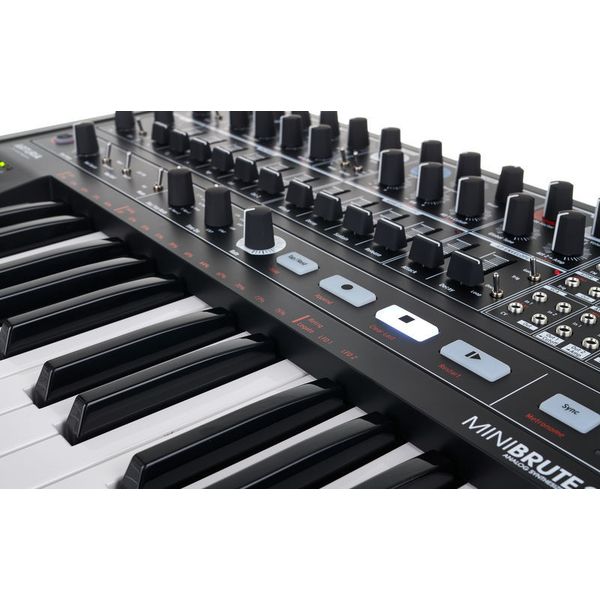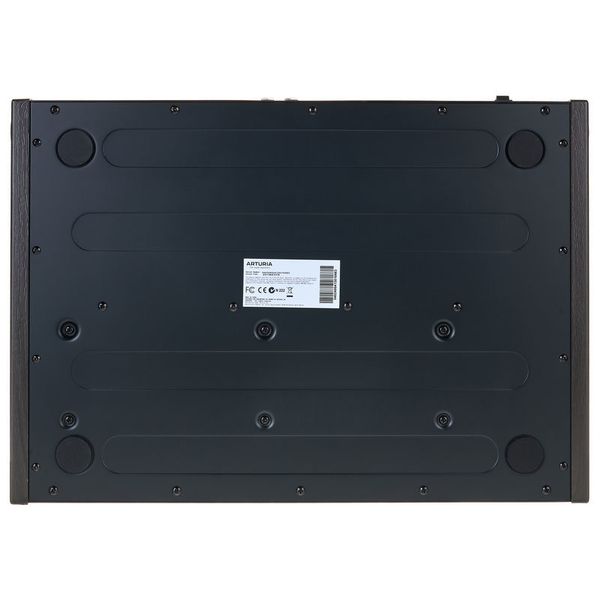
Arturia's MiniBrute 2 Noir is a semi-modular monophonic analogue synthesizer built for hands-on sound design, live tweaking, and modular expansion. A redesigned Brute architecture combines two VCOs, a characterful Steiner-Parker multi-mode filter, and the signature Brute Factor feedback stage to deliver fat basses, sizzling leads, or chaotic analogue textures. In contrast to its sound, the Noir edition keeps the aesthetic understated, pairing a two-octave keyboard with full panel of controls, a dedicated 48-point patchbay, and an integrated arpeggiator and step sequencer. Despite its dense control surface, the layout remains intuitive: no screens, no patch memory, and no menu-diving – just direct interaction for immediate sonic results.
The MiniBrute 2's sound engine centres on a dual-oscillator analogue architecture designed for bold and aggressive sound shaping. VCO1 generates saw, square, and triangle waves expanded via Arturia's Metalizer waveshaping, Ultrasaw detuning, and pulse-width modulation for harmonic richness. VCO2 contributes sine, saw, or square waves for layering, cross-modulation, and hard-sync textures that create complex timbres. The mixer stage blends noise and external audio before the signal reaches the Steiner-Parker multi-mode filter. This filter provides low-pass, high-pass, band-pass, and notch responses, maintaining clarity and presence even at higher resonance settings. Finally, the Brute Factor feedback drives the sound from subtle saturation to full-blown distortion, while the 48-point patchbay unlocks deeper routing possibilities.
Beyond its core synthesis engine, the MiniBrute 2 offers a versatile set of modulation and performance tools. Two LFOs with multiple waveforms provide rhythmic or audio-rate modulation, while the dual-envelope architecture pairs a classic ADSR with a looping AR/ASR envelope that doubles as a modulation source. Together, these can animate pitch, filter cutoff, or waveshaping parameters, allowing patches to evolve dynamically. The built-in arpeggiator and step sequencer further expand live and studio workflows, allowing basslines, melodic patterns and repeating riffs to be created on the fly and reshaped in real time. Clock synchronisation via internal, MIDI, USB or analogue sources ensures the MiniBrute 2 adapts naturally to studio, hybrid, and live setups.
Arturia's success story began with software emulations of well-known analogue synthesizers such as the Moog Minimoog, Sequential Prophet-5, and Oberheim SEM. The popular software instruments included in the V Collection are still flagship products of the French developer today. Over time, Arturia has gradually expanded its range and now also offers a host of hardware devices, ranging from synthesizers and keyboard controllers to sequencers. Since then, the former software developer has thus also become a household name in the world of analogue synthesizers and other equipment.
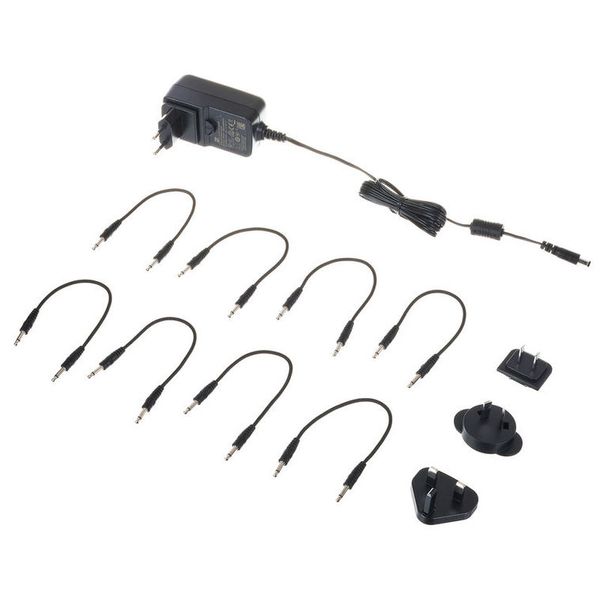
One of the MiniBrute 2's core attributes is its extensive 48-point patchbay, which transforms the instrument from a classic monosynth into a semi-modular sound design powerhouse. Preconfigured internal routings allow the synth to operate immediately without patch cables, while inserting cables overrides these normalled connections, enabling complex signal paths and custom modulation possibilities. Control voltages from LFOs, envelopes, the keyboard, or the sequencer can be freely rerouted across the synthesis engine or sent to external gear. Conversely, external CV and audio signals can be patched into the MiniBrute 2's signal flow, enabling deeper interactions with external systems. This open architecture integrates seamlessly with Eurorack systems, including Arturia's own RackBrute Noir Edition modular cases, extending the instrument's capabilities in style.
Steiner-Parker filter
The Steiner-Parker filter is a cornerstone of the Arturia MiniBrute 2's sonic identity, drawing inspiration from the famous 1970s Steiner-Parker Synthacon. Unlike the smoother ladder filters found in many classic synths, this design delivers a sharper, more aggressive response while retaining clarity and punch even at higher resonance levels. With low-pass, high-pass, band-pass, and notch modes, the filter allows both subtle tonal shaping and radical spectral transformations. Paired with the Brute Factor feedback circuit, it can shift from precise, surgical filtering to saturated, chaotic textures – cementing the MiniBrute's distinctive analogue voice.