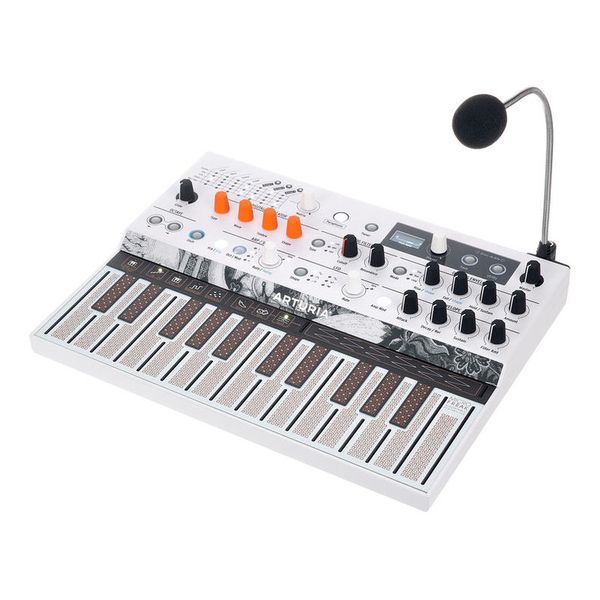
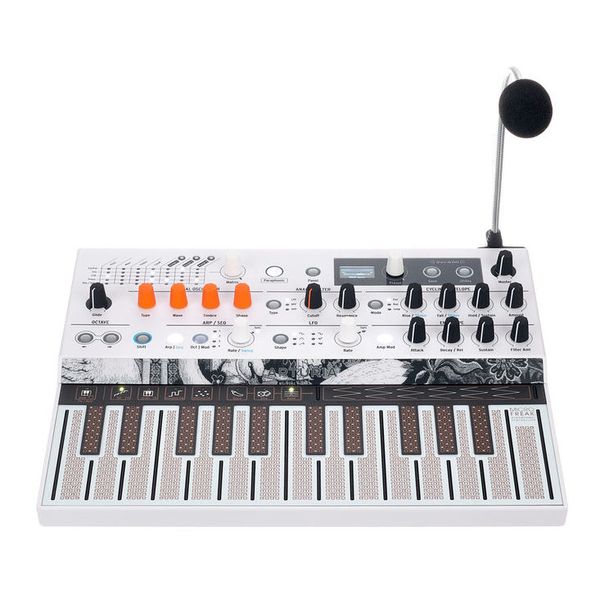
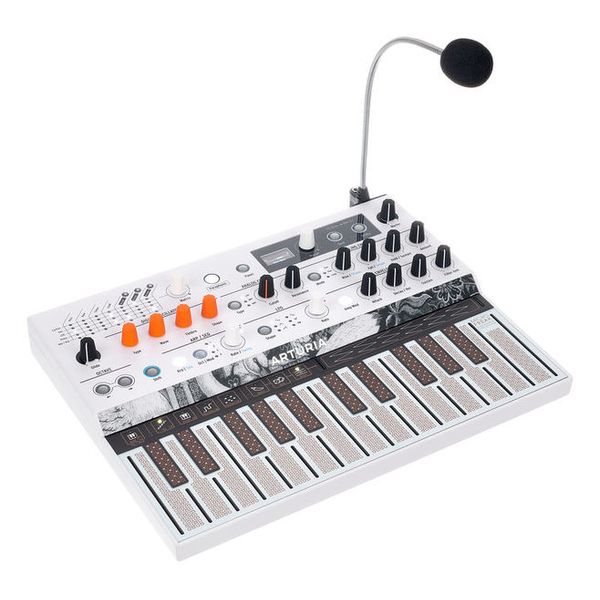
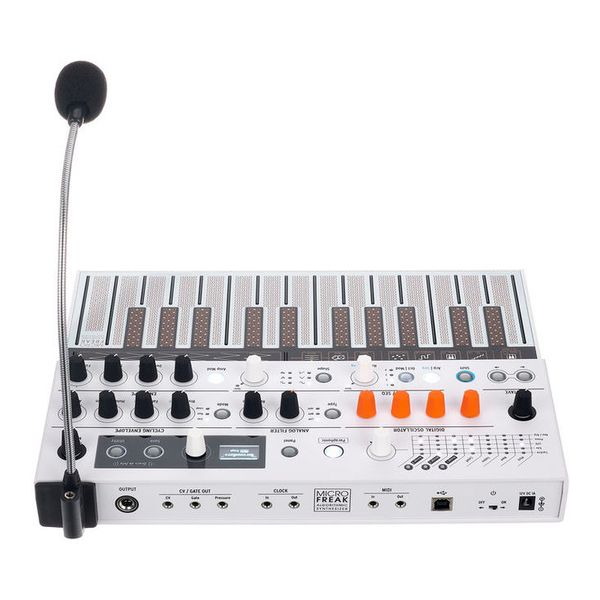
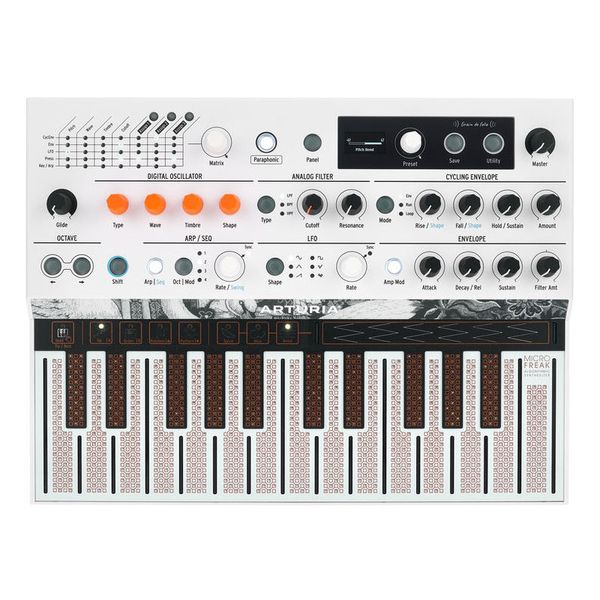
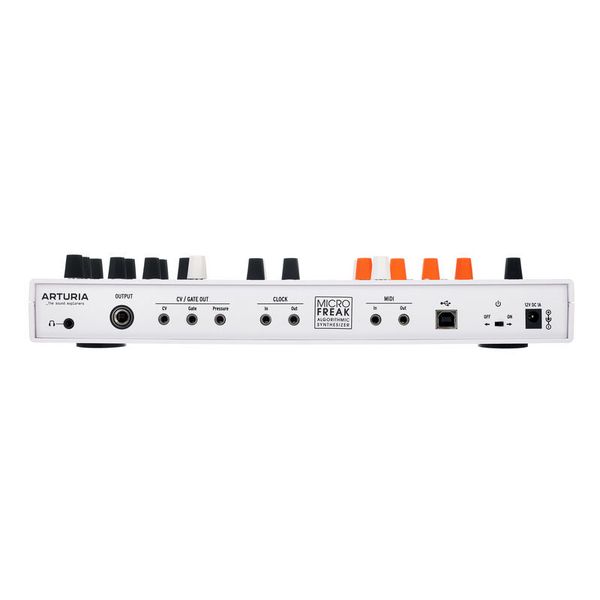
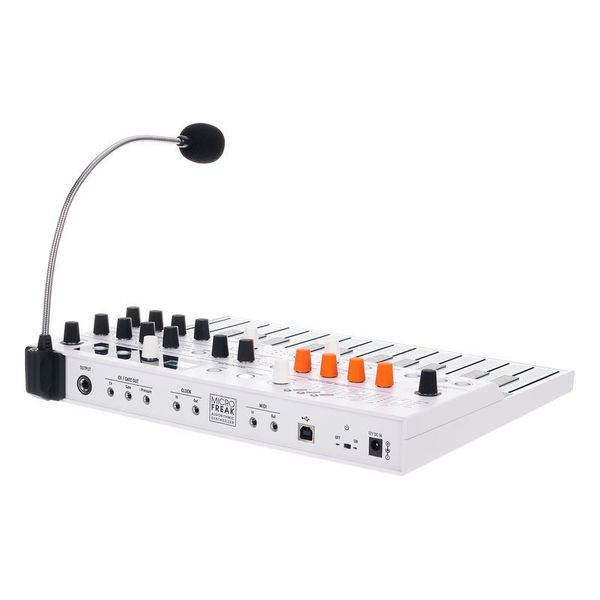
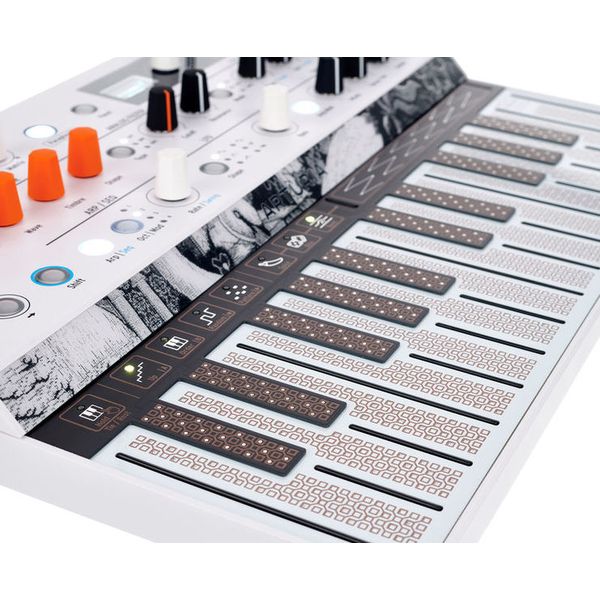
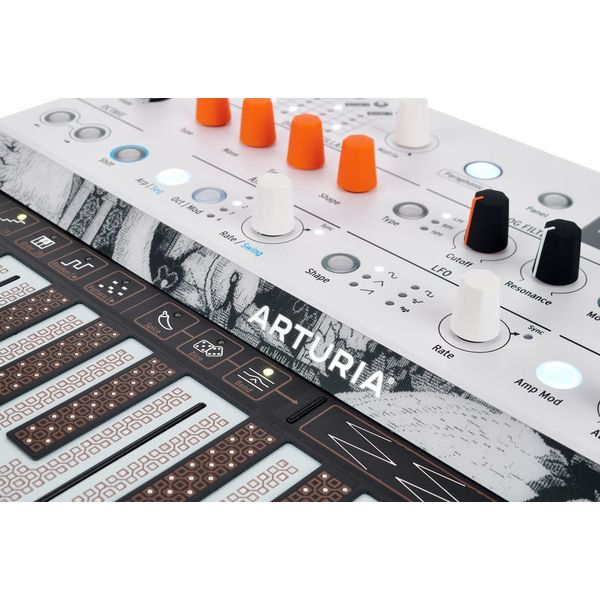
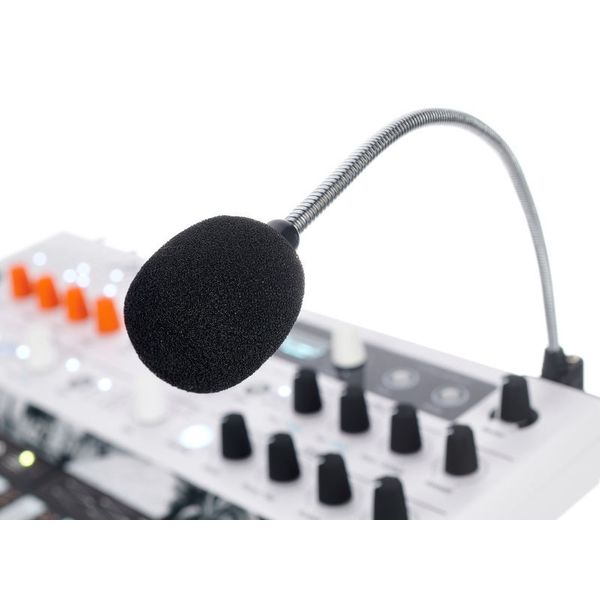
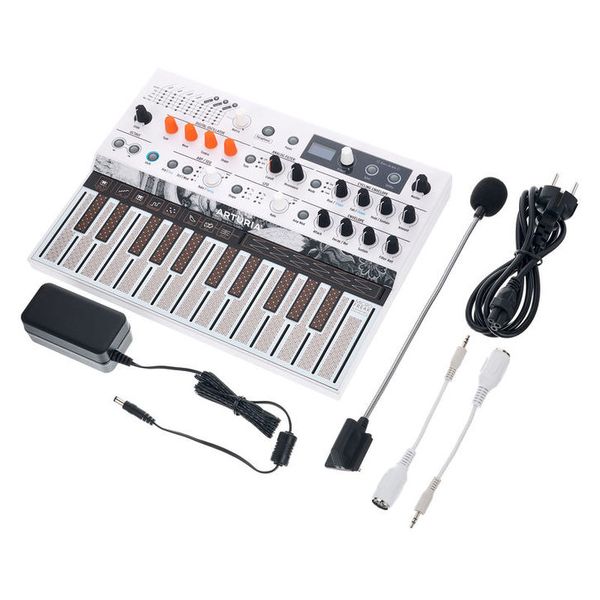
The Arturia MicroFreak Vocoder Edition is an unconventional hybrid synthesizer built for exploratory sound design and performance, in a limited edition equipped with an integrated vocoder engine. At its core lies a versatile digital oscillator engine offering more than 17 oscillator modes – from virtual analogue and FM to wavetable, physical modelling, granular processing, sample-based techniques, and vocoder processing – which feeds a resonant analogue SEM-style filter and is played via a distinctive capacitive keyboard. Positioned at the intersection of modular experimentation and compact hardware synthesis, the MicroFreak combines different sound generation techniques with an immediate, hands-on interface supported by a flexible modulation system and a powerful generative sequencer. MIDI, USB, clock, and CV connectivity allow it to operate equally as a creative sound design platform, controller, and sequencer within modern studio or modular environments. A dedicated gooseneck microphone is included for immediate use of the vocoder.
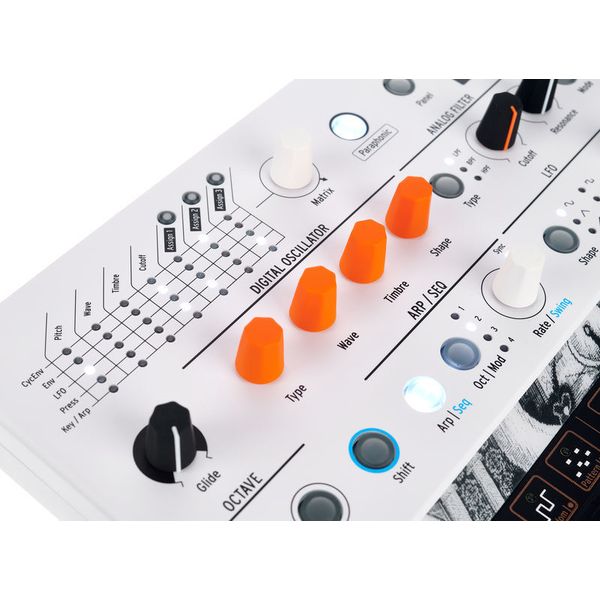
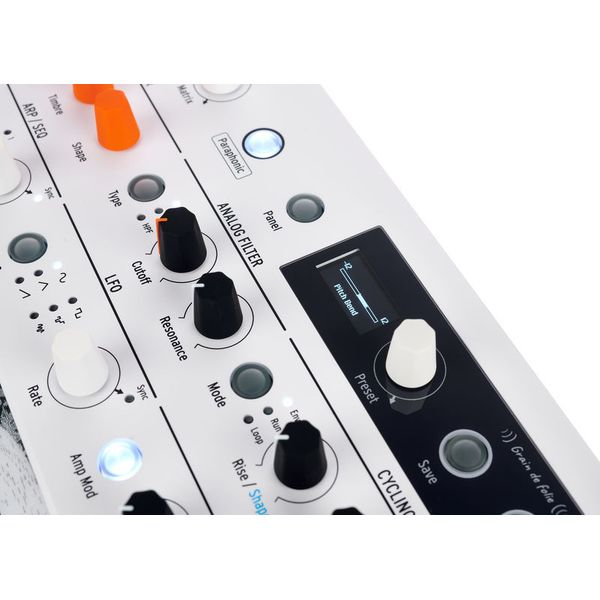
MicroFreak's sound architecture centres on its multi-mode digital oscillator, offering numerous synthesis engines inspired by different traditions – including virtual analogue, wavetable, FM, additive and granular synthesis, plus physical modelling techniques such as Karplus-Strong string simulation. Rather than functioning as conventional oscillators, these modes behave like individual engines with dedicated parameters for shaping timbre and harmonic structure. After the oscillator stage, the signal passes through a resonant analogue state-variable filter inspired by the classic SEM design, providing low-pass, band-pass, and high-pass responses that shape and the oscillator signal. The MicroFreak can operate monophonically or in up to four-voice paraphonic mode, enabling chords and layered textures while sharing a single analogue filter stage.
One of MicroFreak's defining characteristics is its distinctive capacitive keyboard, a flat touch-sensitive surface that transmits both velocity and polyphonic aftertouch on each note. With no moving parts, the PCB keybed responds instantly to subtle changes in pressure and contact that can be modulated to shape timbre and performance behaviour. Above the keyboard, touch controls provide immediate access to the arpeggiator and 64-step sequencer, where notes, gates, and parameter automation can be programmed or edited in real time. The sequencer's Spice and Dice functions introduce controlled randomness into patterns, generating evolving variations while preserving their musicality. The modulation matrix and assignable touch strip complete the creative toolkit, encouraging a hands-on workflow where gestures, patterns, timbres – and now vocal textures – evolve naturally through experimentation.
Arturia's success story began with software emulations of well-known analogue synthesizers such as the Moog Minimoog, Sequential Prophet-5, and Oberheim SEM. The popular software instruments included in the V Collection are still flagship products of the French developer today. Over time, Arturia has gradually expanded its range and now also offers a host of hardware devices, ranging from synthesizers and keyboard controllers to sequencers. Since then, the former software developer has thus also become a household name in the world of analogue synthesizers and other equipment.
At the heart of MicroFreak’s signal path lies a resonant analogue state-variable filter inspired by the classic SEM design, offering low-pass, band-pass, and high-pass modes capable of smooth shaping as well as aggressive resonance or self-oscillation – providing a natural bridge between analogue and digital. Beyond its internal architecture, MicroFreak naturally integrates with modular, hardware, and DAW-based setups. CV, Gate, and Pressure outputs pilot modular systems, carrying notes, sequences, and performance gestures from the keyboard, touch strip, and sequencer – while MIDI and USB connectivity allow it to control external synthesizers and software instruments. Lightweight and capable of running from USB power, MicroFreak can operate equally well as a portable creative instrument, a modular control source, or a dedicated synthesizer within a larger studio setup.
Vocoder engine
The MicroFreak Vocoder Edition extends its hybrid architecture with a 16-band vocoder, supplied with a dedicated gooseneck microphone for immediate vocal processing. External signals or spoken phrases can be analysed by the vocoder and shaped using the MicroFreak's synthesis architecture, producing classic robotic vocals, spectral textures, or rhythmic vocal patterns. Unlike standalone vocoder effects, it integrates directly with the instrument's modulation system, sequencer, and performance controls, allowing vocals to interact with evolving sequences and timbral changes. The result isn't just a vocoder – it's a hybrid vocal instrument where speech, synthesis, and performance gestures merge into a single creative workflow.