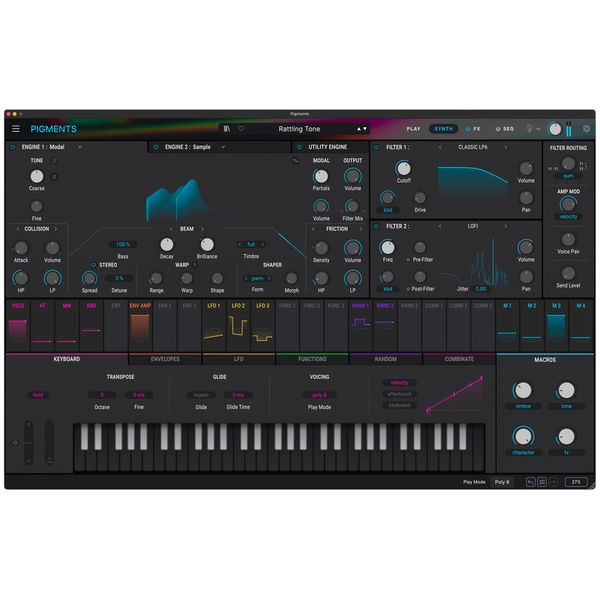
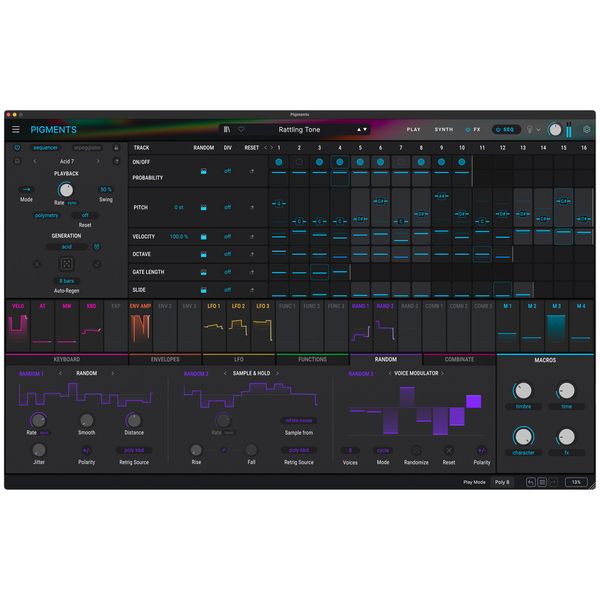
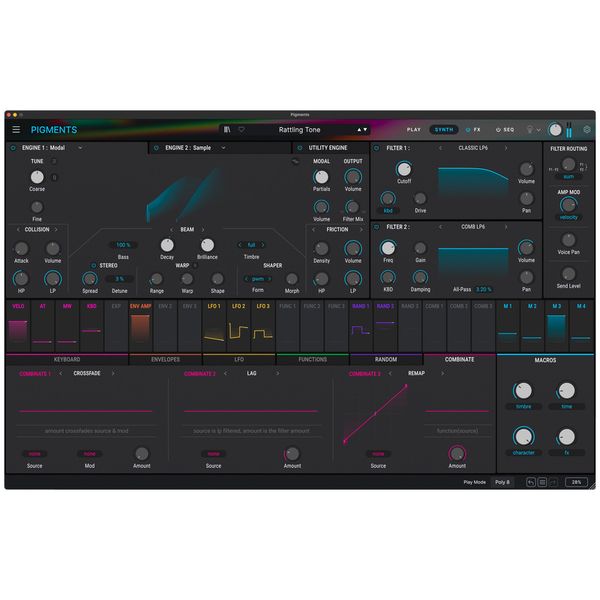
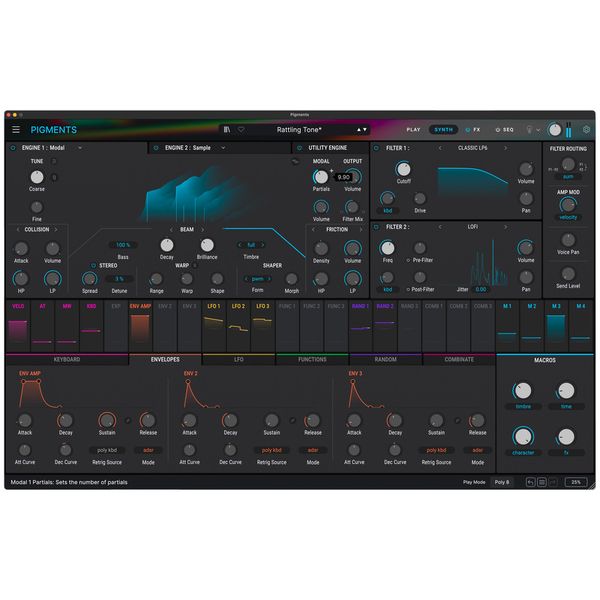
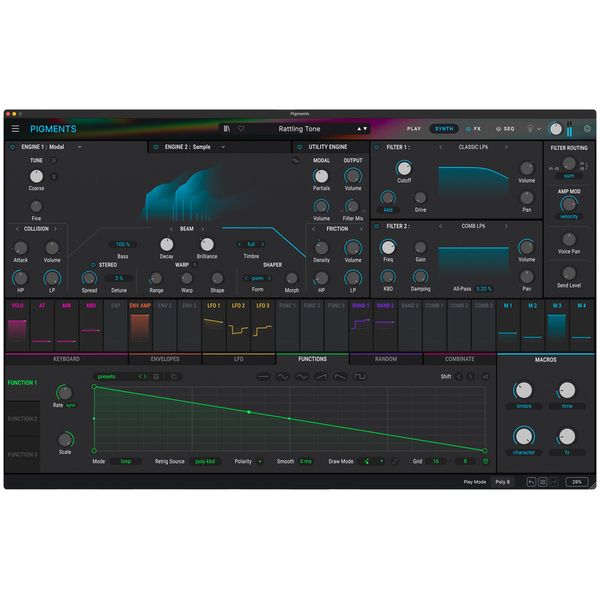
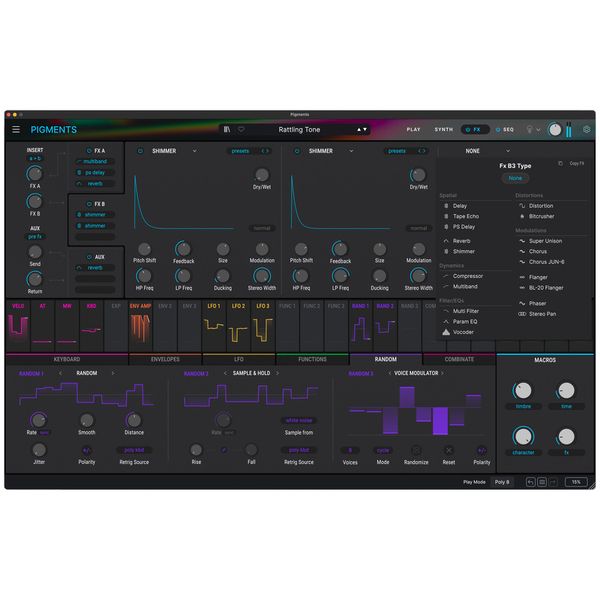
Arturia Pigments is a synthesizer software suite that makes it possible to craft an incredible variety of sounds – thanks to its six sound engines that can call on all sorts of sources for fresh, unusual tones. Pigments gives users full control over a granular engine, a virtual analogue engine, a harmonic engine, a wavetable engine, a modal engine, and a sample & granular engine. There are also 13 different filters onboard, all highly tweakable: Every sound can be modulated almost infinitely, so the results are unsual, unique, and always interesting. New to Version 6 is a vocoder that works with either an external signal input or the sample engine, for even more innovative experimentation. All these features combine to make Arturia Pigments an immensely powerful tool for sound design, giving artists and producers everything they need to shape their own signature sound.
For classic synth sounds – like sine, sawtooth, and square waves – Arturia Pigments' virtual analogue engine comes with three oscillators: It also supports frequency modulation for FM synthesis on the first two oscillators, plus stereo spread for unison voices, and noise generation too. The comprehensive, complex Pigments wavetable engine packs 164 wavetables, each with 256 positions and 2048 samples: Producers can morph between all waveforms smoothly or suddenly, for a very musical sense of flexibility. The UI's browser makes it easy to find and manipulate the wavetables, and custom samples can be loaded as wavetables as well. Arturia has even developed a way of displaying the wavetables in 3D, for a real deep dive into their sonic structure.
With Arturia Pigments 6's sample & granular engine, beatmakers and DJs can use the browser to fill up to six slots with their favourite samples, ready for editing. The samples can all be transposed by semitones and users can also set a custom root note, as well as droping in markers and trigger points. But it's the granular half of this duo where things get really interesting: Arturia Pigments chops the sample into countless tiny slices – the grains – which can themselves be manipulated in great detail, making it possible to create some seriously unusual textures. There's also a raft of controls for even more fine-grained sound design: Grain Shape for the envelope, Grain Size for the length of each grain, and a randomiser for deliberate unpredictably. Version 6 takes this engine even further, adding live sample scanning during playback, randomised grain triggering, and continuous grain-size adjustment for evolving, dynamic sounds.
Arturia Pigments is aimed at experienced sound designers looking for a comprehensive tool to create unique tones. With its suite of six sound engines and a huge range of effects, the possibilities for creative sound generation are practically limitless. That being said, the library of 15,000 ready-made presets also gives newcomers an easy way to find the right sound for their track without hours of tweaking: It's a great way to explore what Pigments is capable of. Equally, Version 6 has plenty of new features to play with, making an upgrade from earlier versions well worth it for seasoned sound explorers. The interface has been redesigned too, with the new Quick Edit V2 giving busy producers a simple drag-and-drop workflow, on top of which Pigments is fully compatible with ODDSound MTS-ESP microtuning and MPE.
Arturia's success story began with software emulations of well-known analogue synthesizers such as the Moog Minimoog, Sequential Prophet-5, and Oberheim SEM. The popular software instruments included in the V Collection are still flagship products of the French developer today. Over time, Arturia has gradually expanded its range and now also offers a host of hardware devices, ranging from synthesizers and keyboard controllers to sequencers. Since then, the former software developer has thus also become a household name in the world of analogue synthesizers and other equipment.
For producers looking to create rich textures around which they can then build their tracks, Pigments offers a resonator based on six parallel band-pass filters; lo-fi vibes can in turn be dialled in with a bit crusher. Linear modulation comes courtesy of the Freq Mod function, while Ring Mod delivers metallic tones perfect for bell-like stabs and hits. The Multimode V2 filter brings twelve different modes to the table, including low-pass, high-pass, band-pass, and notch. And for that warm, analogue character, there are emulations of classic MS-20, SEM, Matrix 12, and Jup-8 filters. Mini recreates the iconic 24dB/octave cascade design from the 1960s, while Surgeon pushes things to extremes with a super-steep 64dB/octave slope, and Comb adds a delayed copy of the signal, creating reinforcing and cancelling overtones for unique timbres. But this isn't a comprehensive list of Pigment's features by any means – more like just the "best of".